

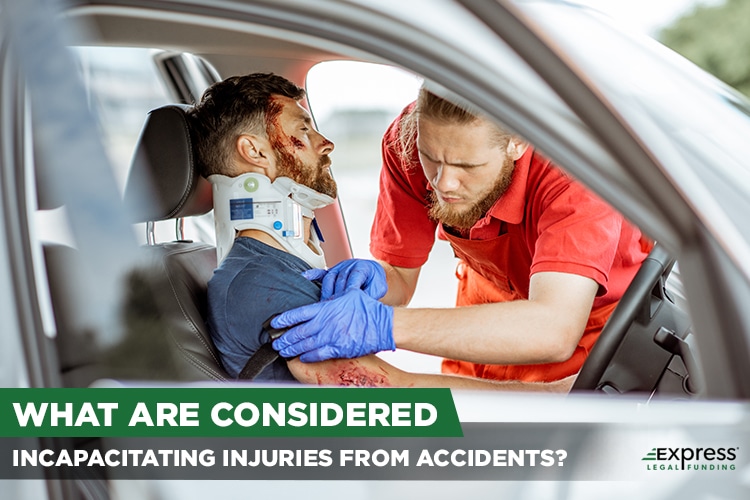
Incapacitating injuries from accidents are serious, nonfatal injuries that prevent a person from walking, driving, or continuing activities they could perform before the accident. In motor vehicle crash reports, the term is commonly associated with the “A” category of the KABCO injury scale, which is now frequently called a suspected serious injury.
The classification can include broken or distorted limbs, severe lacerations, crush injuries, significant burns, suspected internal injuries, unconsciousness, or paralysis. However, an officer’s classification at the scene is not a final medical diagnosis and does not automatically establish permanent disability or the value of a personal injury claim.
This guide explains what qualifies as an incapacitating injury, how it differs from other injury categories, what evidence matters in an injury claim, and whether pre-settlement funding may be available while the case continues.
What is an Incapacitating Injury?
An incapacitating injury is generally a serious, nonfatal injury that prevents an injured person from walking, driving, or normally continuing activities they could perform before the accident. It may also be described as an injury requiring assistance from the scene.
For traffic-safety reporting, incapacitating injuries traditionally fall under category “A” of the KABCO scale. Many updated crash-reporting systems now call this category a suspected serious injury. The Federal Highway Administration’s KABCO definitions show that terminology and precise reporting instructions can vary among states.

Examples commonly associated with this classification include:
- Severe lacerations exposing underlying tissue or causing significant blood loss.
- Broken, dislocated, or visibly distorted limbs.
- Crush injuries.
- Suspected skull, chest, or abdominal injuries.
- Significant second-degree or third-degree burns.
- Unconsciousness when removed from the scene.
- Paralysis.
- Injuries requiring the person to be carried or otherwise assisted from the scene.
The classification describes the apparent severity of an injury for crash-reporting purposes. Doctors later determine the actual diagnosis, required treatment, prognosis, and whether any impairment is temporary or permanent.
Common Accidents That Can Cause Incapacitating Injuries
An incapacitating injury can result from any event involving substantial force, a dangerous fall, crushing pressure, fire, or penetration of the body.

Motor Vehicle Accidents
High-speed collisions, rollovers, pedestrian crashes, motorcycle accidents, and truck accidents can cause broken bones, internal injuries, traumatic brain injuries, spinal damage, severe lacerations, and crush injuries.
Falls and Premises Accidents
Falls from ladders, roofs, stairways, balconies, scaffolding, or other elevated surfaces can cause fractures, head injuries, spinal damage, and internal bleeding. Even a same-level fall can be incapacitating when it causes a hip fracture or serious head injury.
Workplace Accidents
Construction incidents, machinery accidents, falling objects, explosions, electrical accidents, and vehicle crashes can produce amputations, burns, crush injuries, brain injuries, and spinal cord damage. A work-related injury may involve workers’ compensation, a third-party personal injury claim, or both.
Defective Products
Defective vehicles, machinery, power tools, medical devices, or consumer products can cause serious injuries. Potential responsibility may extend beyond the immediate user to a manufacturer, distributor, retailer, maintenance provider, or another party.
Assaults and Other Intentional Acts
Gunshot wounds, stab wounds, severe physical assaults, and other intentional conduct may cause incapacitating injuries. These cases can involve a civil claim even when criminal proceedings are also pending.
How Accident Forces Produce Incapacitating Injuries
Serious injuries often result from rapid acceleration, sudden deceleration, compression, twisting, penetration, or impact with another object. In a vehicle collision, the vehicle may stop before the occupant’s body does, exposing the head, neck, chest, abdomen, and limbs to substantial force.
Falls can produce direct impact injuries and rotational forces, while machinery accidents can crush, pull, cut, or amputate body parts. Burns may result from fire, chemicals, electricity, or heated materials.
The same type of accident can affect people differently. Speed, impact direction, safety equipment, age, prior health conditions, emergency treatment, and the affected body part can all influence the outcome.

Incapacitating vs. Non-Incapacitating Injuries
The distinction concerns the injury’s apparent seriousness and its immediate effect on the person—not simply how much pain the person reports.
| Injury category | General meaning | Possible examples |
|---|---|---|
| Fatal injury | The injury results in death within the reporting period | Fatal head trauma or internal injuries |
| Suspected serious or incapacitating injury | The person cannot continue normal activities or needs assistance from the scene | Major fracture, crush injury, paralysis, severe burn, or significant blood loss |
| Suspected minor or non-incapacitating injury | The injury is visible but does not meet the serious-injury criteria | Bruising, abrasions, or a minor surface laceration |
| Possible injury | The person reports pain or symptoms without an observable qualifying injury | Neck pain, nausea, dizziness, or limping |
| No apparent injury | No injury is observed or reported at the time | No immediate complaint or visible harm |
A person initially classified with a possible or minor injury can later receive a serious medical diagnosis. Conversely, transportation by ambulance does not always establish a permanent or catastrophic injury. Medical evidence ultimately provides a more complete picture than the initial crash-report code.

Is an Incapacitating Injury the Same as a Catastrophic Injury?
Not necessarily. “Incapacitating injury” is commonly used in crash reporting, while “catastrophic injury” is a broader medical or legal description generally associated with severe, life-altering harm.
An incapacitating injury may be temporary. For example, a fracture could prevent someone from walking at the scene but eventually heal. A catastrophic injury—such as permanent paralysis, a major amputation, or profound brain damage—may create lifelong medical, occupational, and personal-care needs.
Neither term establishes negligence or guarantees compensation. Liability, causation, damages, insurance coverage, and applicable law must still be evaluated.
How Does an Incapacitating Injury Affect a Personal Injury Claim?
A serious injury can increase the damages associated with a claim, but the crash-report classification alone does not determine compensation. The injured person must still establish that another party was legally responsible and that the accident caused the claimed harm.
Important evidence may include:
- Emergency and hospital records.
- Diagnostic imaging and surgical reports.
- Specialist evaluations.
- Rehabilitation and therapy records.
- Photographs and accident-scene evidence.
- Employment and lost-income documentation.
- Testimony about limitations on daily activities.
- Expert opinions about future treatment, disability, or earning capacity.
Potential damages may include past and future medical expenses, lost income, diminished earning capacity, pain and suffering, property damage, rehabilitation, assistive equipment, and necessary home modifications. Availability and calculation vary by state and case.
Avoid saying that an insurance company must pay every cost or that an incapacitating classification guarantees a large settlement.

What Can Affect an Incapacitating Injury Settlement?
There is no standard settlement amount for an incapacitating injury. Two people with similar diagnoses may have substantially different claims because of differences in liability, prognosis, employment, treatment, available insurance, and comparative fault.
Factors that may affect compensation include:
- The severity and duration of the injury.
- Whether the impairment is temporary or permanent.
- The cost of past and anticipated medical care.
- Lost income and reduced future earning ability.
- The effect on mobility, independence, and daily activities.
- Available insurance and policy limits.
- Medical liens and reimbursement claims.
- Whether several injured people are competing for the same coverage.
- The strength of the evidence establishing liability and causation.
The most useful figure is not necessarily the gross settlement. It is the amount expected to remain after attorney fees, case costs, medical liens, reimbursement claims, and other deductions.

Can I Get Pre-Settlement Funding for Incapacitating Injuries?
Possibly. Pre-settlement funding for incapacitating injuries may be available when you have an attorney, a pending civil claim, evidence supporting another party’s liability, documented injuries, and an identifiable source of recovery.
A legal funding company will not approve an application solely because a police report labels the injury as incapacitating. The review generally considers the medical evidence, insurance coverage, expected case value, attorney fees, liens, prior advances, disputed fault, and the amount likely to remain for you.
If approved, an advance may help with rent, utilities, groceries, transportation, or other essential expenses while you are unable to work and your attorney handles the claim. Pre-settlement funding is generally non-recourse, subject to applicable law, the agreement, and compliance with its terms. However, the advance and any fees reduce your final recovery, so review the agreement with your attorney and request only what you need.
Closing Statements on Incapacitating Injuries
Incapacitating injuries from accidents are serious nonfatal injuries that prevent a person from continuing normal activities or leaving the scene without assistance. The classification can help describe the apparent seriousness of a traffic injury, but medical records, expert opinions, and evidence of the injury’s long-term effects are more important when evaluating treatment needs and a personal injury claim.
If the injury has left you unable to cover essential expenses while your claim is pending, Express Legal Funding can review your application with your attorney. Approval is not guaranteed, and any advances and fees will reduce your final recovery.

Frequently Asked Questions
The Police Report Says “Possible Injury,” but I Later Needed Surgery. Does That Hurt My Claim?
Not automatically. A crash-report classification reflects information available at the scene. Medical records showing the later diagnosis, its connection to the accident, and the required treatment may provide stronger evidence of your actual injuries.
I Was Able to Walk After the Accident, but Collapsed Later. Can My Injury Still Be Serious?
Yes. Some internal injuries, brain injuries, and spinal conditions may not be immediately obvious. Seek emergency medical attention for worsening pain, confusion, weakness, breathing difficulty, or loss of consciousness.
My Broken Leg Will Probably Heal. Is It Still an Incapacitating Injury?
It may have been classified as incapacitating if it prevented you from walking or continuing normal activities at the scene. The fact that doctors expect recovery does not change its immediate severity, although prognosis affects the claim’s value.
My Employer Says I Can Return to Light Duty, but My Doctor Disagrees. What Should I Do?
Follow your treating provider’s restrictions and give written documentation to your employer and attorney. Conflicting work-capacity opinions may affect lost-income claims and should be addressed through medical and employment records.
Can My Family Apply for Legal Funding if I Am Unable to Handle My Own Affairs?
Possibly, but a relative cannot apply merely because you are hospitalized. The funding company and attorney may require a valid power of attorney, guardianship order, or other legal authority that permits the person to act for you.
Disclaimer: This article is provided by Express Legal Funding for general educational purposes and is not medical, legal, or financial advice. Injury classifications, claim requirements, damages, and funding availability vary by jurisdiction and individual circumstances. Consult qualified medical professionals and review any funding agreement with your attorney before making decisions.

