


You’re on a routine flight — maybe heading home from vacation or on a business trip — when the calm sky suddenly turns violent.
The seat belt sign flicks on, but before you can react, the aircraft jolts downward. Drinks spill, luggage shifts, a few passengers scream, and you feel a sharp pain as you hit your arm against the seat in front of you. When the shaking stops, and your heart rate finally slows, you realize you’re actually hurt.
Now what?
Do you just accept it as bad luck, or is the airline somehow responsible?
It’s an uneasy question, and one with no simple yes or no answer. But understanding how airline liability works in turbulence-related injuries can help you protect your rights and avoid the mistakes that often cost injured passengers the compensation they deserve.
This article will guide you through what turbulence actually is, how the law views it, and under what circumstances an airline might be held accountable.
No legal jargon, no pressure — just clarity, plain and simple.
Can You Sue an Airline for Turbulence?
Yes, you can sue an airline if you were injured during a flight because of turbulence, but success depends on proving negligence.
Key factors that usually determine whether you have a viable claim:
- Foreseeability: Did the airline have reason to expect turbulence from forecasts, pilot reports, or known flight-path risks?
- Safety steps taken: Did the crew act promptly: seat belt sign on, clear announcements, service paused, carts secured?
- Cause of injury: Did something preventable cause the harm, such as an unsecured cart, loose item, or confusing instructions?
- Passenger compliance: Were you wearing your seat belt when instructed, and did you follow crew directions before and during the event?
- Proof and documentation: Can you show medical records, an onboard incident report, witness statements, and timing that links the injury to the flight?
If turbulence was sudden and genuinely unpredictable, and the crew followed proper procedures, airlines are often not liable. If the airline missed warning signs or failed basic safety steps, a personal injury claim may be stronger.
What Is Turbulence (& Why It Happens)

Turbulence is the invisible shaking caused by unstable air currents as an aircraft passes through changing weather patterns, wind shifts, and pressure zones. In simple terms, turbulence is bumpy air—and it’s extremely common. Almost every flight experiences some degree of it, from a light rumble to a sharp jolt.
Turbulence rarely harms the plane, but it can cause injuries if passengers are unbuckled or objects in the cabin aren’t secured.
Types of Turbulence
Common causes of turbulence include:
- Clear Air Turbulence (CAT): Happens suddenly at high altitude, often without clouds or storms to warn pilots. Hardest to predict.
- Weather fronts and storms: Shifting air around thunderstorms or fronts.
- Thermal Turbulence: Caused by warm air rising and cool air descending, mostly experienced over land on warm days while flying in lower altitudes.
- Mechanical Turbulence: Caused by wind flow over man-made structures, disrupting air flow.
- Wake Turbulence: Created by other aircraft — particularly larger planes.
Modern jets are built to handle these conditions safely, and pilots train extensively to respond. So even when turbulence feels terrifying, commercial airliners are structurally sound enough to ride it out.
Why Turbulence is Increasing
Climate patterns are shifting, and studies suggest global turbulence incidents are rising due to stronger jet streams. That means while flying remains one of the safest forms of travel, the likelihood of in-flight injuries from sudden turbulence is trending upward.
Typical Injuries from Turbulence
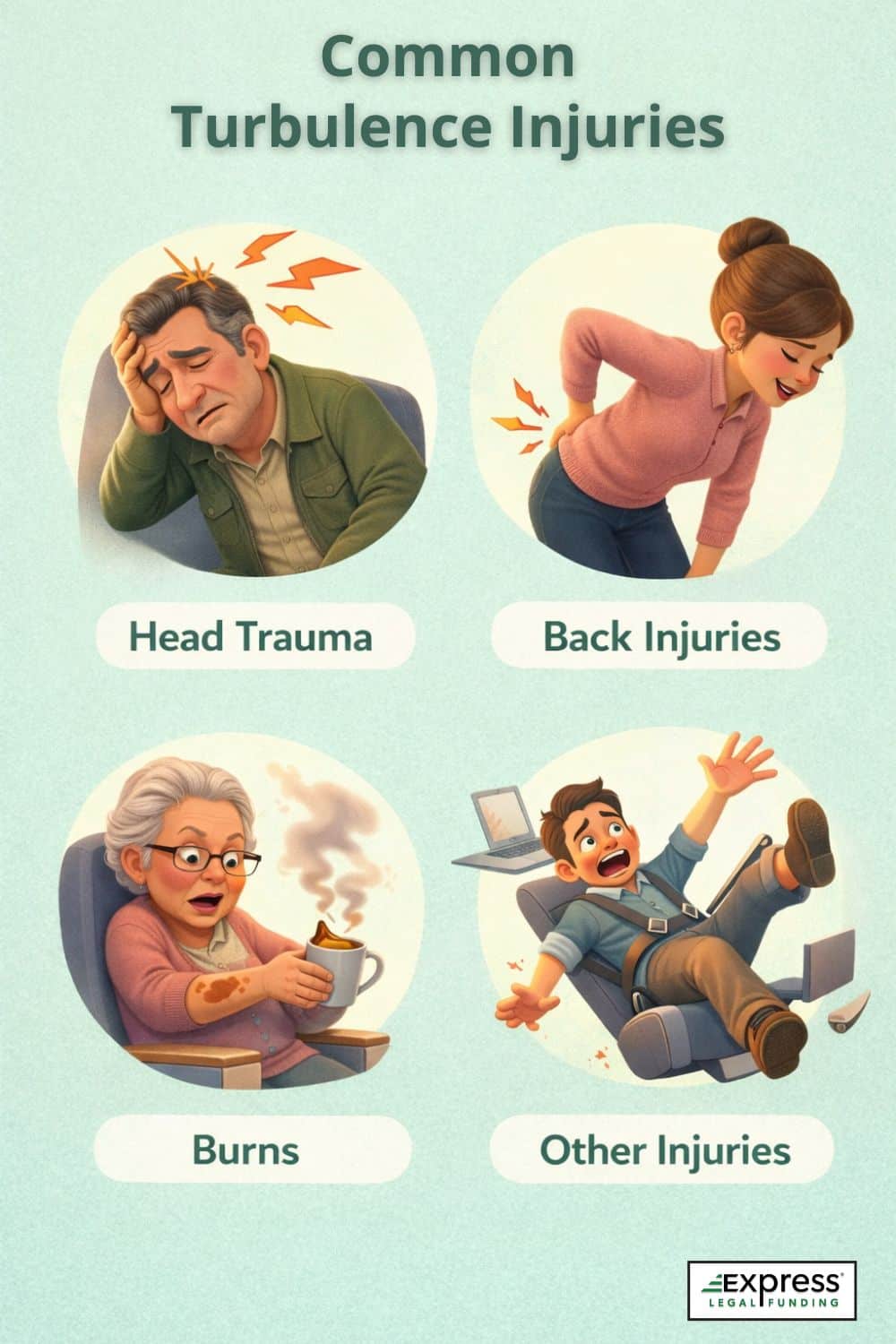
For most people, turbulence means a bit of spilled coffee and a tense grip on the armrest. But for some, it leads to real injury, often because of unpredictability or momentary lapses in safety.
Passengers
Common passenger injuries include:
- Head and facial trauma: From striking overhead bins, walls, or tray tables.
- Back and neck injuries: Whiplash-like motion during severe jolts.
- Broken bones or sprains: Occur when people stand, walk to restrooms, or reach for bags right before turbulence hits.
- Scalds and burns: From hot drinks spilled in laps.
Not wearing a seat belt during calm flights is a common reason injuries become serious. Passengers sometimes unbuckle when the sign is off, unaware that turbulence can arise unexpectedly.
Flight Crew
Flight attendants face an even higher risk. They’re often up and moving when turbulence starts.
In fact, most in-flight injuries reported to the FAA involve flight attendants who are injured during turbulence, often after being struck by service carts or thrown against cabin structures while attempting to secure the cabin.
Secondary Injuries
Some passengers also develop delayed pain syndromes — soft tissue injuries or spinal disc issues that appear days later. Emotional distress (anxiety or fear of flying) can follow, especially after severe turbulence or medical emergencies midair.
Legal Foundations: Who Can You Hold Responsible for Airplane Turbulence

Every airline has a duty to protect passengers during a flight. That duty includes taking reasonable steps to prepare for and respond to known risks such as predicted turbulence. It doesn’t guarantee that the journey will be perfectly smooth, but it does mean the airline must act with care once it becomes aware of potential danger.
Injury claims against airlines depend on proving negligence. Lawyers often explain negligence through four connected ideas: duty, breach, causation, and damage. The airline must have owed a duty of safety, breached that duty through careless behavior, and that failure must have directly caused measurable harm.
If turbulence struck without warning, but the crew reacted professionally, an injury alone may not justify a lawsuit. However, when safety procedures fall short, legal responsibility can come into focus.
Airline Conduct That Can Create Liability
A claim becomes stronger when evidence shows the airline acted carelessly. Examples include:
- Ignoring turbulence alerts or reports from air traffic control.
- Delay in turning on the seat belt sign or making announcements.
- Failing to secure carts, equipment, or overhead items that later caused harm.
- Giving passengers confusing or contradictory safety information.
- Offering little or no help once the flight ended and injuries were obvious.
Such scenarios can demonstrate inadequate care. Proving them requires documentation or witness testimony, which is why reporting the incident right away and seeking medical evaluation matters so much.
Situations Where Airlines Are Not Liable
Turbulence often happens without warning, sometimes in clear skies.
Courts often decline to hold airlines responsible for turbulence when:
- It couldn’t be predicted through instruments or data.
- Flight crew followed all FAA regulations and airline operating procedures.
- The injured passenger ignored seat belt instructions.
- The injury was minor and not truly connected to turbulence or cabin conditions.
Legal outcomes depend on small details. Following directions and securing documentation builds the foundation for any possible claim.
International Aviation Law vs. U.S. Domestic Airline Injury Law
Airline injury claims are governed by different legal frameworks depending on whether the flight was international or domestic. Identifying which legal system applies is critical, as liability standards, evidentiary requirements, and damage limits differ between international treaties and U.S. tort law.
International Flights: The Montreal Convention
For trips between countries, passenger rights are covered by the Montreal Convention — an international treaty that almost all major airlines follow. Under this treaty, a carrier may be liable if a passenger suffers physical injury on board or during boarding or disembarkation, as long as it resulted from an unexpected external event. In legal language, that event is considered an “accident.”
The turbulence itself may qualify as the “accident,” but compensation beyond the Convention’s strict liability threshold depends on whether the airline’s actions contributed to the injury or worsened its effects.
Emergency descents, hard landings, smoke events, and evacuation injuries often meet this definition, but courts still examine the specific chain of events to determine whether an “accident” occurred.
Two-Tier Liability Structure

The Montreal Convention uses a two-tier liability system:
First tier (strict liability)
Airlines are automatically liable for proven damages up to the applicable SDR-based limit, as periodically adjusted by the International Civil Aviation Organization (ICAO). Passengers do not need to prove negligence at this level.
Second tier (above the SDR limit)
For damages exceeding that threshold, the airline may avoid additional liability only if it proves either:
- It was not negligent, or
- The injury was caused solely by a third party.
Importantly, the Convention bars punitive or exemplary damages. Compensation is limited to provable, compensatory losses.
Note: Claims for emotional distress under the Montreal Convention are generally strongest when tied to documented bodily injury; purely psychological injuries alone are often insufficient.
Domestic U.S. Flights: Negligence and Product Liability Law
Injuries occurring on purely domestic U.S. flights are governed by federal and state tort law, not the Montreal Convention.
Passengers may pursue claims based on:
- Negligence: pilot error, inadequate emergency procedures, poor crew communication, or unsafe evacuation handling.
- Product liability: defective aircraft components, systems, or design flaws attributable to manufacturers.
- Maintenance negligence: improper inspections or repairs by airlines or third-party maintenance contractors.
Unlike international claims, damages on domestic routes are not automatically capped and may include:
- Medical expenses and future care
- Lost wages and diminished earning capacity
- Pain and suffering
- In limited circumstances, punitive damages
However, airlines often raise federal preemption defenses, arguing that FAA regulations govern the applicable standard of care. These issues can shape how claims proceed and which legal theories are available.
Jurisdiction and Practical Limits
Which court hears the case and which laws apply can depend on:
- Whether the flight qualifies as “international carriage”
- The airline’s principal place of business
- Where the ticket was purchased
- The passenger’s residence
Statute of Limitations: Deadlines for Airline Injury Claims
Time limits for filing an airline injury claim depend on whether the flight was international or domestic. Missing these deadlines can permanently bar recovery, regardless of the severity of the injury.
For international flights governed by the Montreal Convention, passengers generally have two years from the date of the incident (or the date the aircraft should have arrived) to file a lawsuit. This deadline is strictly enforced and cannot be extended by state law.
For domestic U.S. flights, statutes of limitations are governed by state and federal law and typically range from one to three years, depending on the jurisdiction and the legal theory involved. Claims against manufacturers or maintenance contractors may be subject to different deadlines.
Because aviation cases often involve multiple parties and overlapping legal frameworks, consulting an aviation injury attorney early is essential to preserve evidence and comply with all applicable filing deadlines.
Evidence That Strengthens a Turbulence Injury Claim
Airlines respond to injury reports with detailed reviews, and most claims fail not because the passenger is wrong, but because the evidence doesn’t clearly connect the injury to the flight.
Strong documentation shows what happened, when, and how the airline responded.
Essential items include:
- Flight information: Flight number, boarding pass, seat location, and travel date. This proves you were aboard the specific flight and identifies where in the cabin the incident occurred.
- Incident report: Request the cabin crew’s official write-up. It’s often submitted to airline safety departments and can be crucial later.
- Medical records: Get examined as soon as the flight ends. Hospital or urgent care documentation links the injury directly to the event. Keep follow-up records too — ongoing treatment shows the seriousness of your injury.
- Witness statements: Fellow passengers or crew may have seen the event. Their neutral testimony often carries more weight than your own recollection.
- Photographs: Visible injuries, spilled items, or interior conditions. A few clear photos taken safely can confirm facts better than words.
- Correspondence: Save every email and message with the airline or its insurer. Dates and tone of responses reveal how quickly and responsibly the carrier handled the situation.
Many passengers underestimate the value of small details. A simple note about who helped them or where they fell can clarify accountability months later when memories fade.
What to Do After the Incident
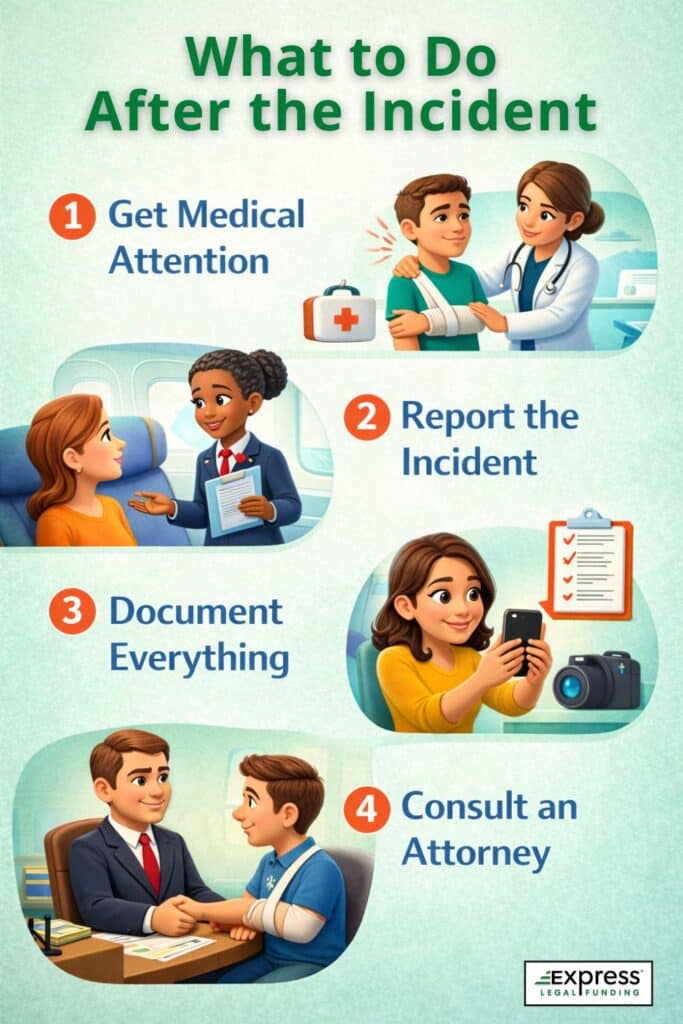
Get medical help right away
Even if the pain feels minor, seek medical evaluation. Internal injuries sometimes show up hours later. Doctors can also verify timing an essential piece of legal proof.
Report the injury to the flight crew
Ask for and complete an incident report before leaving the plane. Describe what happened factually. Do not estimate causes or blame anyone; just state the circumstances.
Photograph and document
If conditions allow, take safe photos of your seat area, any spilled items, and signs of the turbulence aftermath. Save your boarding pass and receipt together.
Keep every relevant document
Store medical bills, prescriptions, and travel papers in one place. When you talk with a lawyer later, having a clear file saves weeks of confusion.
Ask a qualified lawyer for review
An attorney experienced in aviation claims can tell you if negligence likely exists and how jurisdiction works for your flight. Sometimes they uncover internal reports or data that passengers can’t access alone.
Protect privacy and rights
Avoid sharing details online or accepting “apology vouchers.” Posts and informal settlements often waive future rights or give airlines material to challenge your credibility. The quiet approach — careful documentation and professional advice — almost always leads to stronger results.
6 Common Pitfalls That Weaken Compensation Claims
Turbulence-related claims often begin strongly but fall apart because of small, avoidable mistakes. Airlines count on these oversights — they know passengers rarely understand how evidence or timing affects liability.
Failing to report the injury immediately
Many travelers are embarrassed or want to avoid fuss. They think, “I’ll deal with this later.” Yet airlines review every claim by comparing medical and crew reports. If cabin staff didn’t record an injury, the carrier can argue it never happened on board. Even a short, calm report filed right after landing establishes proof the airline can’t easily dispute later.
No medical documentation connected to the flight
You might go home and visit a doctor days later, but the gap in time gives their legal team room to claim your injury happened somewhere else. Immediate care — even at an airport clinic — ties the injury to the incident firmly. Keep all draft and final medical notes; they’re the backbone of any claim.
Filing too late
Legal deadlines arrive fast. Domestic cases usually have only one to three years for filing; international cases under the Montreal Convention have two.
If you miss that window, courts will dismiss valid injuries without review. Contacting a lawyer early isn’t being pushy — it’s self-protection.
Accepting quick settlements or apology vouchers
Airlines sometimes reach out with “gesture of goodwill” offers: flight credits, small payments, or free mileage. Hidden in the fine print is language releasing them from liability. Accepting that compensation can erase your right to pursue full payment for medical costs and suffering. Always have a lawyer review settlement paperwork before signing.
Confusing emotional distress with physical harm
Feeling anxious or frightened after severe turbulence is completely normal, but emotional distress claims without accompanying physical injury rarely succeed. Courts need evidence of a tangible, physical impact before adding psychological compensation. Pair real medical documentation with therapy records if trauma develops — never assume fear alone will lead to payout.
Posting details publicly
Airlines quietly monitor social media for passenger commentary. Posts can backfire if they contain exaggerations or timeline inconsistencies. A lawyer-managed conversation is far safer than public storytelling. Every phrase you share online becomes part of your evidence — or the defense’s.
Each mistake listed above takes away clarity. Protecting your claim simply means acting quickly, organizing records, and staying discreet until expert review.
Airline Defenses You Might Face
Airlines rarely deny that turbulence occurred; instead, they argue it wasn’t predictable or that passengers caused or worsened their own injuries. Understanding these defenses helps prepare realistic expectations.
The turbulence was unforeseeable
Air carriers often classify turbulence as an uncontrollable event — a natural occurrence beyond their power to prevent. They present meteorological data to prove that the air instability appeared suddenly and unpredictably.
Safety instructions ignored
If the seat belt sign was on and you were unbuckled, they’ll argue personal choice caused harm. The defense can strengthen the claim of passenger negligence by referencing video data or crew reports.
Pre-existing medical conditions
An airline may claim your injury was aggravated by prior health problems, like chronic back pain or limited mobility, rather than caused by turbulence itself. They request medical history to support this argument, which underscores how vital prompt examination after the flight becomes.
Compliance with FAA regulations
If the crew reacted under approved safety rules — turning on the seat belt sign in time, securing items, assisting passengers — the airline claims full compliance. When procedures were followed to the letter, courts generally side with them.
Comparative negligence
In some jurisdictions, even partial responsibility reduces compensation. If you stood to retrieve a bag against instructions, courts may assign a percentage of fault to you. That fraction directly cuts the award amounts.
Anticipating these defenses shapes your strategy. A strong evidentiary file and early legal advice undercut every one of these objections.
Possible Compensation When a Claim Succeeds

If negligence is proven, compensation covers both immediate and longer-term losses. Exact sums depend on medical evidence and jurisdiction, but the categories remain consistent.
Medical expenses
Bills for hospital visits, emergency care, surgery, medication, physical therapy, and follow-ups. Payment can include out-of-pocket costs not covered by insurance.
Lost income
Time missed from work because of injuries or medical appointments is recoverable. Severe injuries may also cover projected future earnings lost due to limitation or disability.
Pain and suffering
Financial value assigned to physical pain and the overall difficulty experienced during recovery. Courts review treatment records and testimony to gauge severity.
Emotional distress
Recognized when mental health treatment confirms sustained anxiety, depression, or trauma triggered by the incident. Compensation here is often limited compared with physical injuries, but still acknowledged.
On international flights governed by the Montreal Convention, emotional distress claims are typically only eligible for compensation when linked to documented bodily injury.
Long-term rehabilitation and support
For fractures, spinal injuries, or lasting impairment, settlements include extended care, medical devices, home modifications, and therapy costs far beyond the initial bill.
Special damages
Applied to extraordinary loss — permanent disability, chronic condition, or major lifestyle alteration. This category supports costs that don’t neatly fit medical or wage boxes but stem directly from the injury.
These forms of compensation together rebuild what turbulence disrupted — health, income, and daily stability. Each grows from documented proof that negligence existed and harm followed.
5 Practical Challenges of Suing Airlines
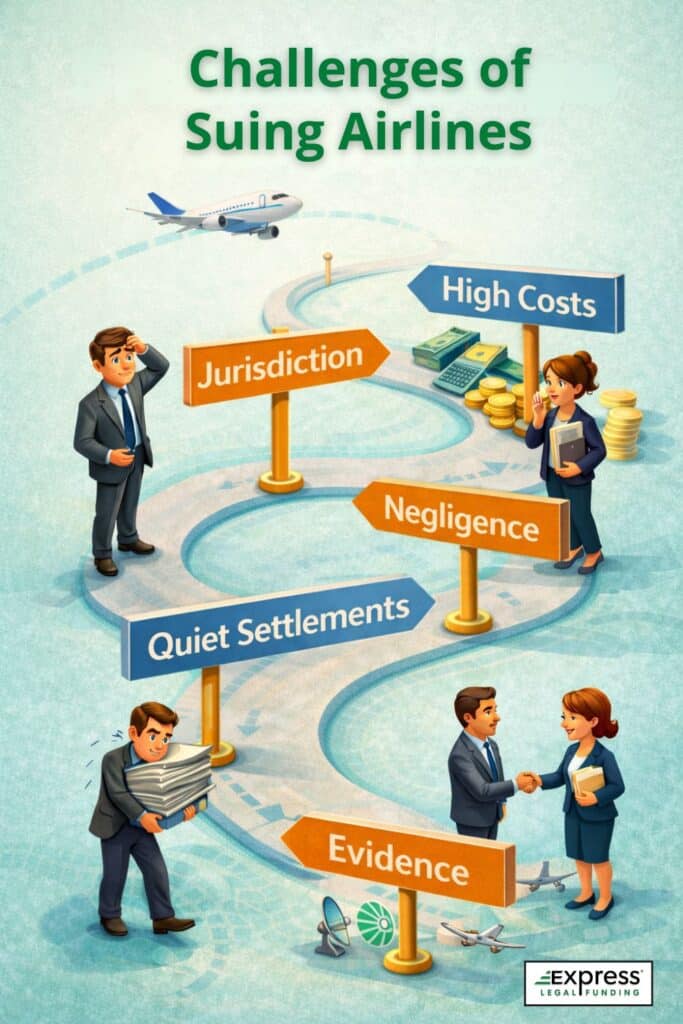
Holding an airline responsible for a turbulence-related injury isn’t as straightforward as filing a standard personal injury claim. Even when passengers follow every recommended step, certain hurdles make these cases complicated.
Jurisdictional complexity
Airlines operate across multiple states and countries. Determining where to file a claim depends on departure and arrival locations, the airline’s headquarters, and sometimes even ticket purchase terms. This web of overlapping jurisdictions demands precise legal navigation.
High cost of litigation
Aviation cases require technical evidence and specialized testimony. Expert witnesses, travel depositions, and investigation costs can easily exceed what most individuals can afford upfront. This is one reason settlements become more common — they reduce expenses for both sides before courts get involved.
Proving negligence against experienced defense teams
Large carriers have dedicated legal departments and access to meteorologists, flight data analysts, and expert witnesses. They use this network to argue that turbulence was natural and unavoidable. Plaintiffs need equally credible specialists who can interpret flight data, atmospheric charts, and cockpit communication to identify mistakes.
Quiet settlements and lack of precedent
Airlines prefer confidentiality when compensating passengers. As a result, very few decisions become public records. This lack of precedent makes it difficult for future claimants to reference prior cases as evidence of liability.
Central role of evidence and expert input
Every successful turbulence claim eventually comes down to evidence. Meteorologists can explain whether flight paths crossed high-risk zones. Aviation engineers assess whether the cabin layout contributed to harm. Medical experts translate a diagnosis into proof of physical suffering caused by negligence. Without these voices, even compelling stories remain unverified.
These realities don’t mean pursuing justice is impossible, only that preparation and professional guidance shape outcomes far more than emotion or persistence alone.
Emotional & Financial Impact on Victims

Physical injuries grab attention first, but recovery often extends far beyond medical bills. The human cost of turbulence injuries is both emotional and financial, and ignoring either can delay real healing.
Physical recovery
Fractures, head trauma, and soft-tissue injuries can take months to heal. Some victims develop chronic pain or loss of mobility, complicating everyday tasks and potentially forcing career adjustments.
Psychological stress
It’s common to experience post-flight anxiety, insomnia, or panic when traveling again. Severe turbulence creates a sense of helplessness that can evolve into post-traumatic stress, especially when the incident involved screaming passengers or emergency landings.
Lost income and opportunity
Extended recovery cuts hours at work or halts employment altogether. Contractors and hourly workers feel this impact almost immediately. When insurers or airlines stall, financial anxiety amplifies the stress of recovery.
Growing expenses during long negotiations
Healthcare costs rise while legal discussions progress slowly. Some families use savings or credit cards just to stay afloat, which turns financial strain into long-term debt.
Value of early openness and help
Talking early with legal and funding professionals keeps problems contained. Honest disclosure about financial or emotional strain allows those teams to coordinate resources before desperation leads to harmful choices, like premature settlements.
Behind every legal claim sits a human story of physical pain and uncertainty. Recognizing that emotional truth makes the guidance you’re providing far more trustworthy.
On a Concluding Note About Whether Passengers Can Sue Airlines for Turbulence
Air safety relies on honesty, not blame. While negligence should be challenged, not every turbulence injury results from wrongful behavior. Balance matters — understanding both passenger rights and aviation realities prevents unnecessary litigation while still protecting genuine victims.
Even then, a severe turbulence event can alter how someone views flying forever, but knowledge and preparation shift control back to the passenger.
Understanding rights turns fear into focus. The path to recovery involves evidence, patience, and expert guidance rather than confrontation alone.
Legal actions against airlines succeed when they prove preventable negligence — not through anger, but through clear documentation and persistence.
For those managing both injury and financial strain, Express Legal Funding offers a lifeline that makes healing possible while justice takes shape. Focus on your recovery; let a trusted legal and funding team handle the pace of litigation.
Can You Get Pre-Settlement Funding for a Turbulence Injury Claim?

Possibly, if you have an attorney handling a viable injury claim against the airline or another responsible party. A turbulence injury by itself does not guarantee funding. The funding company needs to assess whether the claim is likely to produce enough compensation to support an advance.
What Evidence Will a Funding Company Review?
The records discussed earlier in this guide also matter during funding review: your flight details, the crew’s incident report, witness accounts, medical records, and proof of missed work. Your attorney may also have information about the airline’s response and which law applies to your flight. Together, these details help an underwriter assess the injury, the available evidence, and the likely recovery.
If you have been unable to work while the claim is pending, an advance may help cover immediate living expenses. Ask for the full cost in writing and have your attorney explain how repayment would affect the amount you ultimately keep. Approval and the amount offered depend on the case review; an advance and its charges reduce your recovery if the claim succeeds.
Frequently Asked Questions About Whether You Can Sue an Airline for Turbulence
Can turbulence injuries cause long-term medical problems?
Yes. Whiplash, spinal compression, and head trauma can leave lingering effects that intensify over time. Follow-up therapy ensures these conditions are documented for both health and legal reasons.
Do airlines usually settle out of court?
Yes, many airline injury claims resolve through settlement rather than a public trial. Airlines often prefer negotiated agreements because they can reduce legal costs, limit uncertainty, and keep the details of an incident private.
Does compensation differ between international and domestic flights?
Yes. International flights follow the Montreal Convention’s liability rules, which can cap certain damages. Domestic cases fall under state negligence law, which may allow for broader recovery.
What if personal property was damaged or lost during turbulence?
Passengers may claim reimbursement for belongings destroyed in the incident, though limits apply based on ticket terms and international treaties.
Can flight attendants injured in turbulence receive compensation?
Yes. In most cases, flight attendants injured during turbulence seek benefits through their employer’s workers’ compensation (or an airline-specific injury/benefits process), rather than filing a passenger-style personal injury claim. Depending on the facts, they may also have additional rights if a third party (such as a manufacturer or maintenance provider) contributed to the injury.
How long do these cases take to resolve?
Minor injuries can settle within months; major negligence cases often stretch one to three years due to evidence reviews and negotiation cycles.

