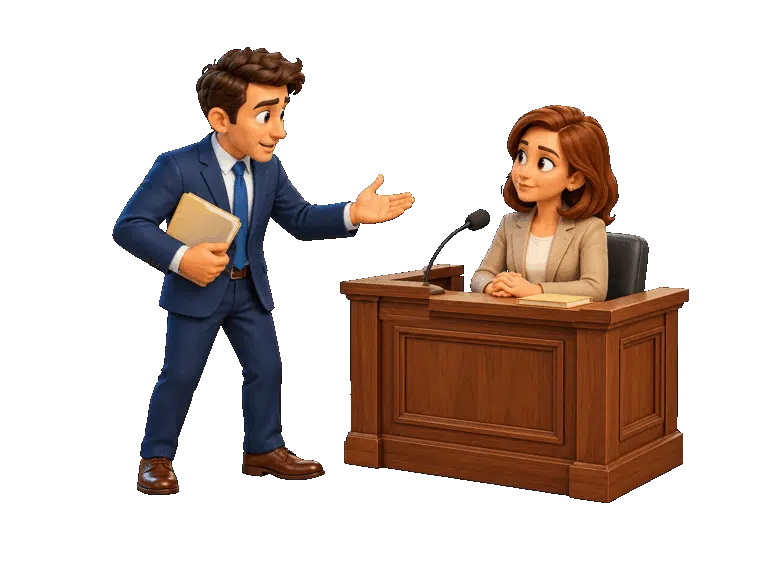
Cross-examination is the questioning of a witness by the opposing party after the witness has testified on direct examination. Its purpose is to test the witness’s accuracy, credibility, memory, perception, opinions, and version of events.
In a personal injury trial, cross-examination may be used to question the injured plaintiff, defendant, eyewitnesses, treating physicians, accident-reconstruction experts, employers, and other people who provide testimony.
The Legal Information Institute defines cross-examination as the opposing party’s questioning of a witness, often through targeted or leading questions intended to test the testimony.

What Is the Purpose of Cross-Examination?
Cross-examination gives the opposing party an opportunity to examine whether a witness’s testimony is complete, reliable, and consistent with other evidence.
An attorney may use cross-examination to:
- Clarify vague or incomplete testimony.
- Expose inconsistencies.
- Test the witness’s memory and perception.
- Reveal bias, interest, or motive.
- Challenge an expert’s qualifications or methods.
- Compare testimony with documents, photographs, or recordings.
- Limit an exaggerated or overly broad opinion.
- Obtain facts that support the cross-examining party’s case.
- Help the judge or jury evaluate credibility.
Cross-examination is not limited to proving that a witness is dishonest. A witness may be truthful but mistaken because of poor visibility, stress, limited opportunity to observe, faded memory, or incomplete information.
What Is the Usual Order of Witness Examination?
Witness testimony generally follows this sequence:
- Direct examination: The attorney who called the witness asks the initial questions.
- Cross-examination: The opposing attorney questions the witness.
- Redirect examination: The original attorney may address matters raised during cross-examination.
- Recross-examination: The opposing attorney may receive another opportunity to question the witness about matters raised on redirect.
The judge controls the order and scope of testimony. Redirect and recross are not unlimited opportunities to repeat earlier questions.
What Is the Scope of Cross-Examination?
In federal court, cross-examination generally should not extend beyond the subject matter covered during direct examination and issues affecting the witness’s credibility. However, the judge may permit questions about additional matters.
Rule 611 of the Federal Rules of Evidence gives judges reasonable control over witness examinations to help determine the truth, avoid wasting time, and protect witnesses from harassment or undue embarrassment.
State rules differ. Some states permit broader cross-examination into any relevant issue, while others more closely limit questions to the direct testimony and credibility.
Are Leading Questions Allowed During Cross-Examination?
Yes, leading questions are ordinarily permitted during cross-examination. A leading question suggests the answer or asks the witness to confirm a specific fact.
For example:
You were looking at your phone immediately before the collision, correct?
Leading questions allow the cross-examining attorney to control the subject and request short, focused answers.
Leading questions are generally restricted during direct examination because the attorney should not ordinarily supply testimony to a friendly witness. Exceptions can apply when questioning a hostile witness, adverse party, child, or person who has difficulty communicating.
Cross-Examination vs. Direct Examination
Direct examination and cross-examination serve different purposes.
| Direct examination | Cross-examination |
|---|---|
| Conducted by the attorney who called the witness | Conducted by the opposing attorney |
| Usually uses open-ended questions | Often uses leading questions |
| Allows the witness to explain events | Tests, limits, or challenges the testimony |
| Develops the calling party’s evidence | Examines credibility and competing interpretations |
| Generally avoids suggesting answers | May suggest specific answers for confirmation |
A witness remains under oath during both direct and cross-examination.
How Does Cross-Examination Work in Personal Injury Cases?
Personal injury trials often depend on conflicting accounts of the accident, medical evidence, and the extent of damages. Cross-examination allows each side to test those subjects before the judge or jury.
Cross-Examination of the Injured Plaintiff
The defense may question the plaintiff about:
- How the accident occurred.
- Statements made at the scene.
- Prior accidents or injuries.
- Preexisting medical conditions.
- Gaps or changes in treatment.
- Missed medical appointments.
- Work history and claimed lost income.
- Daily activities before and after the injury.
- Social media posts.
- Travel, hobbies, exercise, or physical activity.
- Differences between deposition and trial testimony.
- The damages being requested.
Prior injuries do not automatically defeat a personal injury claim. They may become relevant when the defense disputes whether the accident caused or aggravated the plaintiff’s condition.
Cross-Examination of the Defendant
The plaintiff’s attorney may question the defendant about:
- Actions immediately before the accident.
- Speed, visibility, and traffic conditions.
- Distractions or phone use.
- Safety rules or company policies.
- Statements made to police or insurers.
- Training and experience.
- Vehicle maintenance.
- Previous testimony.
- Inconsistencies with photographs, recordings, or physical evidence.
In a commercial vehicle case, cross-examination may also address schedules, dispatch instructions, hours-of-service records, inspection duties, and the driver’s relationship with the company.
Cross-Examination of Eyewitnesses
An eyewitness may be questioned about the ability to see, hear, remember, and accurately interpret what happened.
Relevant subjects may include:
- Distance from the event.
- Lighting and weather.
- Obstructions.
- Duration of the observation.
- Stress or distractions.
- Whether the witness knew either party.
- Statements made shortly after the accident.
- Differences between earlier and current accounts.
The goal may be to show that an honest witness had only a limited opportunity to observe the event.
Cross-Examination of Treating Physicians
A treating physician may testify about diagnosis, treatment, prognosis, restrictions, and whether the accident caused or worsened a condition.
Cross-examination may address:
- The medical history provided by the patient.
- Prior treatment involving the same body part.
- Objective and subjective findings.
- Diagnostic test results.
- Alternative causes.
- Missed appointments.
- Whether the physician reviewed earlier records.
- The necessity and cost of treatment.
- The basis for future-care recommendations.
- Whether the physician was paid for testimony.
The opposing attorney generally cannot require a physician to guarantee a conclusion with absolute certainty. The applicable legal standard for medical causation varies by jurisdiction.
Cross-Examination of Expert Witnesses
Experts may offer opinions about medicine, accident reconstruction, engineering, vocational limitations, future care, economics, or other technical matters.
Cross-examination may test:
- Education, licensing, and experience.
- The information reviewed.
- Assumptions used.
- Testing methods.
- Scientific or professional support.
- Missing evidence.
- Alternative explanations.
- Prior inconsistent opinions.
- Compensation for reviewing the case and testifying.
- The percentage of work performed for plaintiffs or defendants.
Being paid does not automatically make an expert unreliable. Compensation may still be explored as a possible source of bias or interest.
Cross-Examination of Corporate Representatives
A company may designate a representative to testify about matters within the organization’s knowledge. In a personal injury lawsuit, this could involve safety policies, employee training, maintenance, recordkeeping, or the circumstances of an accident.
Cross-examination may compare the representative’s testimony with internal records, emails, policies, inspection documents, and testimony from individual employees.
What Is Impeachment During Cross-Examination?
Impeachment is the process of challenging a witness’s credibility. It is related to cross-examination but is not identical to it. An attorney may cross-examine a witness without attempting to impeach that person.
Common impeachment methods include showing:
- A prior inconsistent statement.
- Bias or personal interest.
- Limited ability to perceive or remember.
- Contradiction by other evidence.
- Certain qualifying criminal convictions.
- Conduct bearing on truthfulness when permitted.
- Unreliable expert methods or assumptions.
Under Rule 607 of the Federal Rules of Evidence, any party may attack a witness’s credibility, including the party that called the witness.
The admissibility of impeachment evidence depends on the applicable rules and the judge’s rulings.
How Are Prior Inconsistent Statements Used?
An attorney may compare a witness’s trial testimony with an earlier statement from a deposition, recorded interview, police report, written response, email, or another source.
A difference is not automatically proof of dishonesty. The inconsistency may result from misunderstanding, incomplete questioning, refreshed memory, or the passage of time.
Rule 613 of the Federal Rules of Evidence governs the use of prior statements for impeachment in federal court. Subject to judicial discretion, a witness generally must receive an opportunity to explain or deny a prior inconsistent statement before extrinsic evidence of that statement is introduced.
State evidence rules may impose different procedures.
Can an Attorney Ask Any Question on Cross-Examination?
No. Questions remain subject to evidence rules, the scope of direct examination, and the judge’s authority.
An attorney may object when a question is:
- Irrelevant.
- Misleading or confusing.
- Argumentative.
- Asked and answered repeatedly.
- Based on facts not established.
- Improper hearsay.
- Protected by privilege.
- Speculative.
- Unfairly prejudicial.
- Harassing or unnecessarily embarrassing.
The judge may sustain the objection, overrule it, require the question to be rephrased, or instruct the jury to disregard an improper statement.
Can Cross-Examination Become Harassment?
Cross-examination can be firm and challenging, but it should not become abusive. Judges have authority to protect witnesses from harassment and undue embarrassment while still allowing legitimate credibility testing.
The nature of the case may require questions about sensitive subjects, including medical history, mental health, finances, relationships, or prior trauma. Relevance does not give an attorney unlimited authority to humiliate a witness.
Attorneys can request protective measures or object to improper questioning when appropriate.
Cross-Examination vs. Deposition Questioning
A deposition is sworn testimony taken outside the courtroom during discovery. Cross-examination usually refers to questioning an opposing witness at a hearing or trial.
| Deposition | Trial cross-examination |
|---|---|
| Conducted during discovery | Conducted before a judge or jury |
| Often explores information broadly | Usually presents focused points |
| Creates a transcript for case preparation | Tests testimony in court |
| May lead to new evidence | Relies heavily on evidence already developed |
| Can preserve testimony | May influence the final verdict directly |
Deposition testimony often becomes important during cross-examination because it provides a record of what the witness previously said.
How Should a Personal Injury Plaintiff Prepare for Cross-Examination?
Preparation should focus on truthful, careful testimony—not memorizing scripted answers.
A plaintiff should:
- Review the deposition and important records with counsel.
- Listen to the complete question.
- Pause before answering.
- Answer only what was asked.
- Avoid guessing.
- Ask for clarification when a question is confusing.
- Correct an answer promptly if a mistake is made.
- Distinguish between what is known and what is assumed.
- Remain calm even when questions feel confrontational.
- Avoid arguing with the attorney.
- Tell the truth about prior injuries and treatment.
- Use words rather than gestures when a spoken record is required.
“I do not know” and “I do not remember” are appropriate answers when truthful. They should not be used to avoid answering information the witness actually knows.
Can Cross-Examination Affect a Personal Injury Settlement?
Yes. Deposition testimony, expert opinions, and anticipated cross-examination risks often affect settlement evaluations before trial.
A party may reconsider settlement when testimony reveals:
- Stronger or weaker liability evidence.
- Credibility problems.
- An unsupported medical opinion.
- A persuasive eyewitness.
- Inconsistent accounts.
- Uncertain future damages.
- Evidence of shared fault.
- Strong documentation supporting the plaintiff’s limitations.
Cross-examination does not establish a settlement amount by itself. It is one part of the overall evaluation of liability, causation, damages, insurance coverage, and trial risk.
Does Cross-Examination Affect Pre-Settlement Funding?
Potentially. If a case has progressed to depositions or trial preparation, a funding company may consider sworn testimony, expert evidence, credibility disputes, and the attorney’s assessment of trial risk when reviewing the claim.
A difficult deposition or expected cross-examination does not automatically make a case ineligible. The effect depends on whether the testimony materially changes liability, causation, damages, or the expected recovery.
Express Legal Funding does not control testimony, choose witnesses, or direct trial strategy. Those matters remain between the client and attorney. Any funding decision depends on underwriting, applicable law, and the case’s expected net value.
Example of Cross-Examination in a Personal Injury Trial
Suppose Elena testifies that a store’s broken handrail caused her to fall down a staircase. During direct examination, she describes the fall, her surgery, and her resulting difficulty walking.
On cross-examination, the store’s attorney asks whether Elena was looking at her phone and whether she previously reported a similar knee condition. Elena’s attorney later uses redirect examination to clarify that the earlier condition affected the opposite knee and that surveillance footage shows her phone remained in her purse.
The questioning allows the jury to evaluate the complete context rather than relying on a single statement.
Frequently Asked Questions
What if I Realize During Cross-Examination That My Deposition Answer Was Wrong?
State the correction truthfully and explain the reason if asked. Do not attempt to hide the inconsistency. Your attorney may use redirect examination to provide necessary context.
Can the Defense Ask About an Accident That Happened Years Earlier?
Possibly, particularly when the earlier accident involved the same body part or symptoms. Your attorney may object when the event is irrelevant, too remote, or presented in an unfairly prejudicial manner.
What if I Do Not Understand the Cross-Examining Attorney’s Question?
Say that you do not understand and ask for the question to be repeated or rephrased. Do not answer a question based on what you think the attorney might mean.
Can the Defense Show the Jury My Social Media Posts During Cross-Examination?
Potentially, if the posts are authenticated, relevant, and admissible. Your attorney may challenge misleading, altered, incomplete, or unfairly prejudicial material.
Can My Attorney Talk to Me During Cross-Examination?
Your attorney can make objections and may speak with you during ordinary breaks, subject to the judge’s instructions and ethical rules. A judge may restrict attorney-witness discussions during certain breaks while testimony is ongoing.
Disclaimer: This vocabulary page is provided by Express Legal Funding for general educational purposes and does not constitute legal or financial advice. Cross-examination procedures, evidentiary rules, objections, and funding considerations vary by jurisdiction and case. Consult a qualified attorney about preparing for testimony or making decisions concerning your claim.