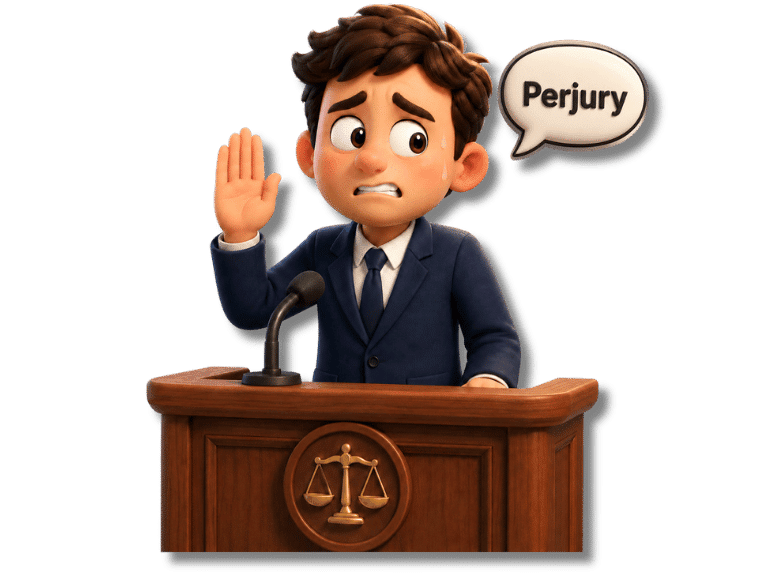
In simple terms, perjury means lying when you have sworn or legally promised to tell the truth. It can happen in court, during a deposition, in an affidavit, in a declaration signed under penalty of perjury, or in another official legal setting where truthful statements are required.
Not every wrong statement is perjury. A person usually does not commit perjury because they made an honest mistake, forgot a detail, misunderstood a question, or gave an answer that later turned out to be inaccurate.
Perjury generally requires a knowingly false statement, made intentionally, under oath, about something material to the case or proceeding.

What Does “Under Oath” Mean?
Being under oath means a person has sworn or affirmed that they will tell the truth. This can happen when a witness testifies in court, answers questions at a deposition, signs an affidavit, or submits a written declaration under penalty of perjury.
An oath does not always require a dramatic courtroom moment. Many written legal documents include language stating that the signer declares the information is true under penalty of perjury. Signing that type of document falsely can create serious legal consequences.
The Main Elements of Perjury
For a statement to qualify as perjury, several key elements usually must be present.
First, the person must make a statement under oath or under penalty of perjury. Second, the statement must be false. Third, the person must know or believe the statement is false when they make it. Fourth, the false statement must involve a material issue.
These elements matter because perjury is not the same as being confused, mistaken, nervous, or forgetful. The law focuses on intentional dishonesty about something important to the legal process.
Examples of Perjury
Perjury can occur in many legal settings where a person is required to tell the truth under oath or under penalty of perjury. Common examples include:
- Falsely denying being at the scene of an accident when evidence shows the person was present.
- Lying during a deposition about prior injuries, medical treatment, employment history, income, or how an accident occurred.
- Signing a sworn affidavit or declaration that contains information the person knows is false.
- Providing false testimony in court about a material fact that could influence the outcome of a case.
- Knowingly submitting false information in a sworn legal document, such as a financial disclosure or witness statement.
- Giving false testimony before a grand jury or other official legal proceeding after taking an oath to tell the truth.
If a knowingly false statement concerns a material fact and is made under oath or under penalty of perjury, it may result in serious criminal penalties and affect the person’s credibility in future legal proceedings.
What Is Not Perjury?
A false statement is not automatically perjury. If someone gives an incorrect answer because they misunderstood the question, remembered the event incorrectly, or made a genuine mistake, that is usually not perjury.
Opinions are also different from false factual statements. For example, saying “I thought the driver was speeding” may be an opinion or estimate, while falsely claiming “I saw the driver run the red light” when the person did not see it may raise a more serious issue.
Why Materiality Matters in Perjury
Materiality is one of the most important parts of perjury. A false statement is material if it could influence the legal proceeding, even if it does not ultimately change the final outcome.
For example, lying about whether you signed a contract, witnessed an accident, received medical treatment, or spoke with another party may be material. These facts can affect liability, damages, credibility, or the direction of the case.
Perjury in Civil Cases
Perjury can occur in civil lawsuits, not just criminal trials. Civil cases include personal injury claims, car accident lawsuits, employment disputes, contract cases, and other non-criminal legal matters.
In a personal injury case, perjury may involve lying about how the accident happened, the extent of injuries, prior medical history, missed work, or treatment records. These issues can affect settlement negotiations, case value, and credibility.
Perjury in Criminal Cases
Perjury in a criminal case can be especially serious because false testimony may affect someone’s liberty, charges, or sentence. Witnesses, defendants, officers, and other parties can face consequences if they knowingly lie under oath.
However, criminal perjury charges still require proof. A contradiction, poor memory, or inconsistent statement does not automatically prove that someone committed perjury.
Perjury vs. False Statements
Although the terms are sometimes used interchangeably, perjury and false statements are different legal concepts. Perjury generally requires a knowingly false statement made under oath or under penalty of perjury, while a false statement offense may apply even if the person was never sworn in. Which law applies depends on where the statement was made, who received it, and the specific facts of the case.
| Perjury | False Statement |
|---|---|
| Made under oath or under penalty of perjury | May be made without being under oath |
| Usually occurs during court proceedings, depositions, or sworn documents | Often involves statements made to government agencies, investigators, or officials |
| Requires the false statement to concern a material fact | Materiality requirements vary depending on the applicable law |
| Governed by perjury statutes | Governed by separate federal or state false statement laws |
Perjury vs. Lying
Every act of perjury involves lying, but not every lie is perjury. A false statement only becomes perjury when it is knowingly made under oath (or under penalty of perjury) and relates to a material issue in a legal proceeding or sworn document. Ordinary dishonesty, while it may have other consequences, usually does not meet the legal definition of perjury.
| Perjury | Ordinary Lying |
| Made under oath or under penalty of perjury | Can occur in everyday conversations |
| Must involve a material fact | May involve any topic, whether important or trivial |
| May result in criminal prosecution | Usually not a crime by itself |
| Example: Lying during a sworn deposition | Example: Lying to a friend about where you were last night |
Perjury vs. Inconsistent Testimony
Giving inconsistent testimony does not automatically mean someone committed perjury. People sometimes make inconsistent statements because they are confused, mistaken, nervous, or have an imperfect memory. To prove perjury, prosecutors generally must show that the person knowingly and intentionally made a false statement about a material fact—not simply that their testimony changed over time.
| Perjury | Inconsistent Testimony |
| Knowingly making a false statement under oath | Statements that differ from one another |
| Requires intent to deceive | May result from confusion, mistake, or memory lapses |
| Involves a material fact | May involve material or immaterial facts |
| Can lead to criminal charges | Does not automatically establish criminal liability |
When evaluating conflicting testimony, courts often consider the wording of the questions, the surrounding circumstances, available documents, witness credibility, and whether the differences involve an important issue in the case.
What Are the Penalties for Perjury?
In the United States, perjury can lead to criminal penalties, including fines, probation, or imprisonment, depending on the law that applies. Under federal perjury law, a person convicted of perjury may face fines or imprisonment for up to five years, unless another law provides a different penalty.
State penalties vary. Some states treat perjury as a felony, while others have different levels depending on the type of proceeding, the importance of the false statement, and the harm caused.
Can Perjury Affect a Lawsuit?
Yes. Perjury can seriously damage a lawsuit because it affects credibility. If a party or witness lies under oath, the judge, jury, opposing counsel, or insurance company may question other parts of their testimony.
In personal injury cases, credibility is especially important. Even one false statement about medical treatment, accident details, lost wages, or prior claims can create problems during settlement negotiations or trial.
How Attorneys Handle Possible Perjury
If an attorney believes a client, witness, or opposing party may have lied under oath, the issue must be handled carefully. Lawyers may review transcripts, compare testimony with documents, question the witness further, or bring the issue before the court when appropriate.
A person who is worried about a mistaken statement should speak with their attorney as soon as possible. Correcting an error early may be very different from allowing a knowingly false statement to remain part of the record.
Why Perjury Matters in Personal Injury Claims
Perjury matters in personal injury claims because these cases often depend on testimony, medical records, accident reports, and witness statements. The truthfulness of each party can affect both liability and damages.
For example, if an injured plaintiff exaggerates symptoms or hides a prior injury, the defense may use that issue to challenge the entire claim. If a defendant lies about texting while driving or running a red light, that false statement may become a major credibility issue.
How Perjury Relates to Legal Funding
Pre-settlement funding companies do not decide whether someone committed perjury. That issue belongs to attorneys, courts, and prosecutors. However, truthful case information is important when applying for legal funding because the funding company and attorney review the strength and status of the claim.
If a lawsuit is affected by false testimony, credibility problems, or disputed facts, that may impact how the case is evaluated. Plaintiffs should always be truthful with their attorney and avoid guessing when they do not know or remember an answer.
Related Legal Terms
Perjury is often connected to other legal terms, including oath, affidavit, deposition, testimony, material fact, witness, declaration, false statement, obstruction of justice, and subornation of perjury.
Subornation of perjury means encouraging, persuading, or causing someone else to commit perjury. This is also a serious legal issue because it involves interfering with the truth-seeking process of the courts.
Frequently Asked Questions About Perjury
Can I be charged with perjury if I correct my testimony later?
It depends on the circumstances. Correcting a statement does not automatically eliminate the possibility of a perjury charge, but voluntarily correcting an honest mistake before it affects the legal proceeding may be viewed differently than intentionally allowing a false statement to remain on the record. If you realize you testified inaccurately, you should speak with your attorney promptly.
Can someone go to jail for convincing another person to lie under oath?
Yes. Encouraging, pressuring, or persuading someone else to knowingly give false testimony may constitute subornation of perjury, which is a separate criminal offense in many jurisdictions. Both the person giving the false testimony and the person who induced it may face legal consequences.
Can text messages, emails, or videos be used to prove perjury?
Yes. Prosecutors and attorneys often rely on documents, electronic communications, surveillance footage, medical records, financial records, or other evidence to show that sworn testimony was knowingly false. The stronger the evidence contradicting the testimony, the easier it may be to establish credibility issues or support a perjury investigation.
What if two witnesses give completely different versions of the same event?
Different testimony does not automatically mean someone committed perjury. People can remember events differently or observe the same incident from different perspectives. Perjury generally requires proof that a witness knowingly made a false statement about a material fact—not simply that their testimony conflicts with someone else’s.
Can perjury affect someone’s credibility in future court cases?
Yes. If a person is found to have committed perjury or has a documented history of giving false testimony, it may affect how judges, juries, and attorneys evaluate their credibility in future legal proceedings. The impact depends on the circumstances and the rules governing the particular case.
Can I refuse to answer a question if I’m worried my answer might be false?
If you are unsure of the answer, it is generally better to say you do not remember or do not know than to guess. In some situations, you may also have legal rights, such as the Fifth Amendment privilege against self-incrimination, but whether that protection applies depends on the circumstances. An attorney can advise you on how to respond appropriately.
Disclaimer: This article is provided by Express Legal Funding for general educational and informational purposes only and is not legal advice. Perjury laws, criminal penalties, and legal procedures vary by federal and state law, so consult a qualified attorney regarding your specific situation. If you have a pending civil lawsuit and would like to learn about your legal funding options, Express Legal Funding can explain how pre-settlement funding works.