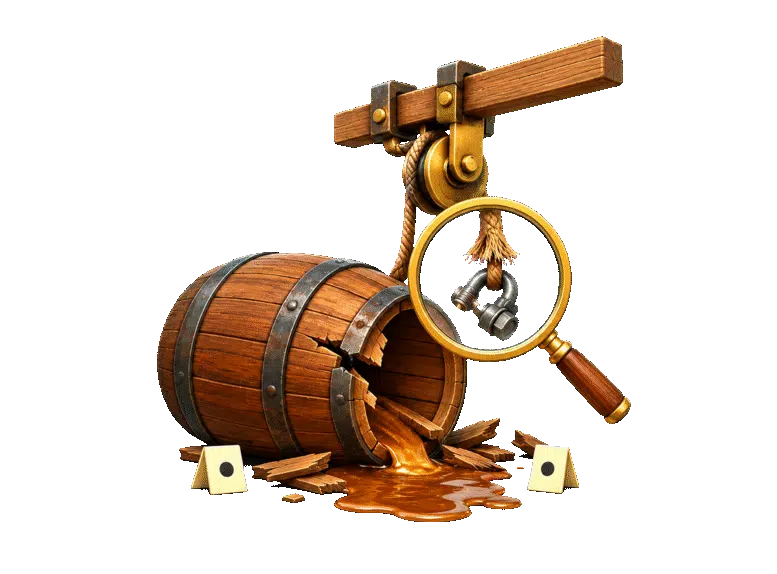
Res ipsa loquitur is a legal doctrine that allows negligence to be inferred from the nature of an accident when direct evidence of the defendant’s specific mistake is unavailable. The Latin phrase means “the thing speaks for itself.”
The doctrine may apply when an accident ordinarily would not occur without negligence, the likely cause was within the defendant’s responsibility or control, and other reasonable causes—including the plaintiff’s own conduct—have been sufficiently eliminated.
Res ipsa loquitur does not automatically prove negligence or guarantee that the plaintiff will win. Its requirements and procedural effect vary by state.

What Does Res Ipsa Loquitur Mean in English?
The literal English translation of res ipsa loquitur is:
“The thing speaks for itself.”
In legal use, the phrase means that the circumstances surrounding an accident may provide enough evidence to support an inference of negligence, even when no witness observed the precise careless act.
It does not mean that the injury alone proves the entire case.
How Do You Pronounce Res Ipsa Loquitur?
A common American English pronunciation is:
/rez IP-suh LOCK-wih-ter/
Pronunciations vary because the phrase comes from Latin. Legal professionals may pronounce individual syllables differently while referring to the same doctrine.
Where Did Res Ipsa Loquitur Originate?
The doctrine is commonly associated with the 1863 English case Byrne v. Boadle.
In that case, a barrel of flour fell from a warehouse and struck a pedestrian. The injured man could not explain exactly how the barrel fell because the relevant activity occurred inside or above the warehouse.
The court concluded that barrels do not ordinarily fall from properly operated warehouses without negligence. The falling barrel provided sufficient preliminary evidence for the negligence question to be considered.
The Byrne v. Boadle decision became the classic illustration of res ipsa loquitur.
Why Is Res Ipsa Loquitur Important?
Negligence often occurs outside the injured person’s view.
A patient under anesthesia cannot observe everything that happens during surgery. A pedestrian cannot see how an object was secured before it fell from a building. An elevator passenger may not know which component failed inside the machinery.
Without res ipsa loquitur, some plaintiffs could be unable to proceed because the defendant controlled the instrumentality and possessed most of the information about the accident.
The doctrine allows circumstantial evidence to fill that gap when the accident itself strongly suggests negligence.
What Are the Elements of Res Ipsa Loquitur?
The traditional formulation generally requires the plaintiff to establish three conditions:
- The accident is the type that ordinarily does not occur without negligence.
- The instrumentality that caused the injury was within the defendant’s exclusive control.
- The injury was not caused by the plaintiff’s voluntary action or contribution.
Modern courts often state the test differently. A modern formulation may ask whether:
- The event ordinarily would not occur without negligence
- Other responsible causes have been sufficiently eliminated
- The indicated negligence falls within the defendant’s duty to the plaintiff
The exact requirements and effect must be determined under the law of the state handling the claim.
The Accident Ordinarily Does Not Occur Without Negligence
The first requirement asks whether common experience or expert evidence shows that this type of accident usually does not happen when reasonable care is used.
Possible examples include:
- A surgical instrument left inside a patient
- An elevator falling unexpectedly
- Secured cargo falling from a commercial truck
- A wheel detaching from a properly maintained vehicle
- A heavy object falling from a controlled worksite
- The wrong body part being operated on
An unusual result alone is not enough. The accident must be one that more likely than not points toward negligence under the applicable legal standard.
What Is an Instrumentality?
An instrumentality is the object, equipment, process, or condition that caused the injury.
It might be:
- A barrel
- A vehicle
- A surgical instrument
- An elevator
- A scaffold
- A machine
- A medical procedure
- A building component
- A load of cargo
- A product
Identifying the relevant instrumentality helps determine who controlled or was responsible for the probable cause of the accident.
What Does Exclusive Control Mean?
The traditional res ipsa loquitur test asks whether the instrumentality was under the defendant’s exclusive control.
Exclusive control does not always require literal physical possession at the exact moment of injury. Modern courts may examine whether the defendant had responsibility for managing, maintaining, inspecting, or operating the instrumentality when the likely negligence occurred.
For example, an elevator maintenance company may not physically possess the elevator when a passenger is injured. However, its responsibility for inspection and maintenance may be relevant to control.
The purpose of the control requirement is to connect the probable negligence to the defendant and sufficiently eliminate other responsible causes.
Can Res Ipsa Loquitur Apply Without Literal Exclusive Control?
Possibly.
Courts may apply a flexible control analysis when:
- The defendant controlled the instrumentality when the likely negligence occurred
- No meaningful alteration occurred afterward
- The defendant had exclusive responsibility for maintenance
- The defendant possessed superior information about the cause
- Multiple defendants collectively controlled the plaintiff’s safety
- Evidence sufficiently eliminates third-party causes
A plaintiff cannot rely solely on the fact that the defendant once handled an object. The evidence must reasonably connect the probable negligence to that defendant or group of defendants.
Must the Plaintiff Eliminate Every Other Possible Cause?
Generally, the plaintiff does not have to disprove every imaginable explanation.
However, the plaintiff usually must present evidence making other responsible causes sufficiently unlikely. The exact standard varies by jurisdiction.
Relevant alternative causes may include:
- The plaintiff’s own conduct
- A third party’s interference
- Product alteration
- Misuse
- An unforeseeable mechanical failure
- A natural event
- An unavoidable accident
If another cause is just as likely as the defendant’s negligence, res ipsa loquitur may not apply.
Must the Plaintiff Identify the Exact Negligent Act?
No. Avoiding that requirement is one of the doctrine’s main purposes.
A plaintiff may be unable to determine whether an elevator failed because of improper inspection, defective maintenance, or incorrect repair. Res ipsa loquitur may allow an inference of negligence without identifying the exact act, provided the other requirements are met.
The plaintiff must still connect the event to the defendant’s legal responsibility.
Can the Plaintiff Have Contributed to the Accident?
The plaintiff’s conduct can affect whether res ipsa loquitur applies.
Under the traditional test, the event must not have resulted from the plaintiff’s voluntary action or contribution.
Modern comparative-negligence systems may use a more flexible analysis. Some courts consider whether the plaintiff’s conduct is a plausible alternative explanation, while others allow a negligence inference but reduce recovery according to comparative fault.
The result depends on state law and the facts.
Is Res Ipsa Loquitur Direct or Circumstantial Evidence?
Res ipsa loquitur is based on circumstantial evidence.
Direct evidence describes the negligent act itself. For example, a witness sees a worker remove a safety bolt and operate the machine without replacing it.
Circumstantial evidence proves surrounding facts from which negligence may reasonably be inferred. For example, a properly secured elevator ordinarily does not fall several floors, and the defendant was responsible for maintaining it.
Cornell Law School’s Legal Information Institute describes res ipsa loquitur as a doctrine allowing plaintiffs to use circumstantial evidence to support negligence.
Does Res Ipsa Loquitur Shift the Burden of Proof?
It depends on the jurisdiction.
Courts generally treat the doctrine in one of three ways:
Permissible Inference
The jury may infer negligence but is not required to do so. The defendant does not necessarily have to prove the absence of negligence.
Rebuttable Presumption
Negligence is presumed after the plaintiff satisfies the doctrine’s requirements unless the defendant produces evidence rebutting that presumption.
Burden-Shifting Rule
In some jurisdictions or circumstances, the defendant may have a greater obligation to explain how the event occurred without negligence.
Even when a burden of producing evidence shifts, the plaintiff may retain the ultimate burden of persuasion.
Burden of Production vs. Burden of Persuasion
These are different legal burdens.
Burden of Production
The burden of production is the obligation to present enough evidence for an issue to be considered.
Res ipsa loquitur may help a plaintiff satisfy this burden on the question of breach.
Burden of Persuasion
The burden of persuasion is the obligation to convince the factfinder that a claim is more likely true than not under the applicable civil standard.
In many jurisdictions, the plaintiff retains the ultimate burden of persuasion even when res ipsa loquitur applies.
Does Res Ipsa Loquitur Automatically Prove Negligence?
No.
The doctrine may permit an inference or create a rebuttable presumption, depending on state law. The defendant may introduce evidence showing that:
- Reasonable care was used
- The event can occur without negligence
- A third party caused the accident
- The plaintiff contributed to the accident
- The instrumentality had been altered
- The defendant did not control the probable cause
- A latent defect could not reasonably have been discovered
- The claimed conduct did not cause the injury
The jury may accept or reject the competing explanations.
Does Res Ipsa Loquitur Prove Every Element of Negligence?
No.
An ordinary negligence claim generally requires proof of:
- A legal duty
- Breach of that duty
- Actual causation
- Proximate causation
- Legally recognized damages
Res ipsa loquitur primarily helps establish that a breach of duty probably occurred. Depending on the jurisdiction and facts, it may also support an inference about causation.
It does not automatically establish:
- That the defendant owed the required duty
- That the inferred negligence caused every claimed injury
- The nature and extent of damages
- That the lawsuit was filed on time
- That no defense applies
Res Ipsa Loquitur vs. Ordinary Negligence
In an ordinary negligence case, the plaintiff may identify the defendant’s specific careless act.
For example, maintenance records show that a mechanic installed the wrong type of wheel fastener.
Under res ipsa loquitur, the plaintiff may not know the precise mistake. Instead, the plaintiff argues that a properly maintained wheel ordinarily does not detach, the defendant was responsible for its maintenance, and other likely causes have been eliminated.
Both approaches seek to prove negligence. They use different forms of evidence.
Res Ipsa Loquitur vs. Negligence Per Se
These doctrines are different.
| Res ipsa loquitur | Negligence per se |
| Relies on the circumstances of an unusual accident | Relies on the violation of a statute or regulation |
| Uses circumstantial evidence to infer negligence | May establish or support breach based on a legal violation |
| Does not require proof of a statutory violation | Requires an applicable statute or regulation |
| Focuses on what ordinarily would not occur without negligence | Focuses on whether the defendant violated a safety rule protecting the relevant person and harm |
Neither doctrine necessarily proves causation or damages.
Res Ipsa Loquitur vs. Strict Liability
Strict liability may impose responsibility without requiring proof that the defendant failed to use reasonable care.
Res ipsa loquitur remains a negligence doctrine. It permits negligence to be inferred from circumstantial evidence.
For example, a defective-product claim may proceed under strict liability without using res ipsa loquitur. A separate negligence claim involving the product’s maintenance might rely on the doctrine.
Res Ipsa Loquitur vs. Prima Facie Evidence
Prima facie evidence is evidence sufficient to support a claim if it is not rebutted.
When a plaintiff satisfies the requirements of res ipsa loquitur, the circumstances may provide prima facie evidence of negligence.
The precise effect depends on whether the jurisdiction treats the doctrine as an inference, presumption, or burden-shifting rule.
Res Ipsa Loquitur vs. Respondeat Superior
These Latin doctrines address different questions.
| Res ipsa loquitur | Respondeat superior |
| Means “the thing speaks for itself” | Means “let the superior answer” |
| Helps infer negligence from circumstantial evidence | May make an employer liable for an employee’s wrongful conduct |
| Concerns proof of negligence | Concerns vicarious liability |
| Does not require an employment relationship | Generally depends on an employer-employee or similar agency relationship |
A case may involve both doctrines. Res ipsa loquitur may help establish negligence, while respondeat superior connects the employee’s negligence to the employer.
What Is a Classic Example of Res Ipsa Loquitur?
Assume a pedestrian walks beside a warehouse. A heavy crate falls from an upper window and strikes the pedestrian.
The pedestrian cannot see which worker handled the crate or which safety procedure failed. However:
- Properly secured crates ordinarily do not fall from warehouse windows
- Warehouse employees controlled the crate
- The pedestrian did not cause it to fall
- No evidence suggests an outside person interfered
Those facts may permit an inference of negligence.
What Is an Example Where Res Ipsa Loquitur May Not Apply?
Assume a customer slips on water in a grocery store.
A fall can occur for many reasons, including the customer’s footwear, an unnoticed spill created seconds earlier by another shopper, or the store’s failure to inspect the area.
The fall alone does not necessarily show that the store was negligent or had sufficient notice of the hazard. Additional evidence would usually be needed.
Res ipsa loquitur does not automatically apply to every unexplained accident.
Can Res Ipsa Loquitur Apply in Medical Malpractice Cases?
Yes, but medical malpractice rules vary significantly by state.
Possible examples include:
- A surgical instrument left inside a patient
- Surgery performed on the wrong body part
- An unexplained burn far from the treatment area
- A patient falling from an operating table while unconscious
- Injury to a body part unrelated to the procedure
- Anesthesia equipment causing an event that ordinarily does not occur without negligence
A poor medical outcome alone generally does not establish res ipsa loquitur. Many known complications can occur without negligence.
Are Medical Experts Required?
Often, yes.
Medical treatment involves technical questions outside ordinary knowledge. An expert may be necessary to establish that:
- The result does not ordinarily occur without negligence
- The relevant instrumentality was within the provider’s responsibility
- Other medical causes are sufficiently unlikely
- The negligence caused the injury
Expert testimony may not be required when negligence is obvious to an ordinary person, such as leaving a surgical sponge inside a patient. State statutes may still impose expert-report or affidavit requirements.
What Is the Ybarra v. Spangard Rule?
The California case Ybarra v. Spangard involved a patient who suffered an unexplained shoulder injury while unconscious during surgery on another part of his body.
Several medical professionals had participated in the procedure, making it difficult for the patient to identify who controlled the instrumentality that caused the injury.
The court allowed a broader use of res ipsa loquitur against the group of defendants who had control over the patient’s body or instrumentalities during the procedure.
Not every state follows Ybarra or applies its reasoning as broadly. Multiple-defendant medical cases remain highly jurisdiction-specific.
Can Res Ipsa Loquitur Apply to Multiple Defendants?
Sometimes.
Multiple defendants create difficulty because the doctrine ordinarily requires the probable negligence to be connected to a particular defendant’s responsibility.
It may apply when:
- The defendants shared control
- They acted together
- Each had responsibility for the plaintiff’s safety
- One defendant is vicariously liable for another
- The jurisdiction recognizes a special multiple-defendant rule
- Evidence sufficiently narrows the responsible group
It generally should not be used merely because several defendants might have caused the harm.
Can Res Ipsa Loquitur Apply in Car Accident Cases?
Possibly, but not every unexplained crash supports the doctrine.
Potential examples include:
- An unattended vehicle rolling downhill
- A properly maintained wheel suddenly detaching
- A vehicle crossing entirely into the wrong lane without an apparent external cause
- A controlled vehicle rolling from a repair facility
- A component detaching immediately after maintenance
The defendant may rebut the inference with evidence of:
- A sudden medical emergency
- An unforeseeable mechanical defect
- Road conditions
- Another driver’s conduct
- Product failure
- Improper repair by a third party
The fact that a collision occurred does not itself prove negligence.
Can Res Ipsa Loquitur Apply When a Driver Leaves the Road?
Some courts permit an inference of negligence when a vehicle leaves its proper lane or roadway under circumstances that ordinarily suggest driver error.
However, other explanations may include:
- A sudden tire failure
- An unexpected obstruction
- A medical emergency
- Another vehicle forcing the driver off the road
- Dangerous road design
- Severe weather
The plaintiff must address reasonable alternative causes.
Res Ipsa Loquitur in Truck Accident Cases
The doctrine may be relevant when:
- Secured cargo falls from a truck
- A tire or wheel detaches
- A trailer separates from a tractor
- A truck rolls while unattended
- A heavy component falls during unloading
Potentially responsible parties may include:
- The driver
- Motor carrier
- Cargo-loading company
- Maintenance provider
- Equipment owner
- Parts manufacturer
- Shipper
Control and causation can become complicated when multiple companies handled the truck or cargo.
Res Ipsa Loquitur in Falling-Cargo Cases
Cargo ordinarily should not fall from a properly loaded and secured commercial vehicle.
A plaintiff may investigate:
- Who loaded the cargo
- Who inspected the securement
- Which company supplied the straps or chains
- Whether the load shifted
- Whether equipment failed
- Whether anyone altered the load
- Whether the driver performed required inspections
The doctrine may support an inference, but it does not automatically identify which party was negligent.
Res Ipsa Loquitur in Premises-Liability Cases
Possible premises-related examples include:
- A ceiling collapsing
- An elevator falling
- A heavy fixture detaching
- A window falling from a building
- Construction material falling onto a pedestrian
- A balcony railing failing under ordinary use
The plaintiff must still connect the probable negligence to a party responsible for maintaining, installing, inspecting, or controlling the condition.
Does Res Ipsa Loquitur Apply to Slip-and-Fall Cases?
Usually not from the fall alone.
People may slip without anyone being negligent. A property owner may also lack actual or constructive notice of a recently created hazard.
Res ipsa loquitur may become relevant in unusual circumstances when the accident strongly indicates negligence and other causes are sufficiently eliminated. However, ordinary premises-liability evidence typically focuses on:
- The dangerous condition
- Who created it
- How long it existed
- Inspection procedures
- Warnings
- Notice
- The plaintiff’s conduct
Res Ipsa Loquitur in Elevator and Escalator Cases
Elevator or escalator malfunctions may support res ipsa loquitur when the event ordinarily would not occur with proper inspection and maintenance.
Examples may include:
- An elevator dropping unexpectedly
- Doors closing with abnormal force
- A floor-leveling failure
- An escalator component detaching
Potential defendants may include the property owner, management company, manufacturer, installation contractor, and maintenance company.
Service records and contracts are important for determining control and responsibility.
Res Ipsa Loquitur in Construction Accidents
Construction examples may include:
- Collapsing scaffolding
- Falling tools
- Dropped building materials
- Crane loads falling
- Temporary structures collapsing
- Equipment moving without an operator
Control can be difficult to establish because owners, general contractors, subcontractors, equipment companies, and workers may share responsibility.
The plaintiff must identify which parties probably controlled the activity or instrumentality when the negligence occurred.
Res Ipsa Loquitur in Product-Liability Cases
Res ipsa loquitur may support a negligence theory involving a malfunctioning product when:
- The event ordinarily suggests negligence
- The product was not materially altered
- Misuse is sufficiently excluded
- The defendant controlled the product when the probable negligence occurred
The doctrine can be difficult to apply after the product passes through distributors, retailers, owners, repair shops, and users.
A product claim may instead proceed under strict liability, breach of warranty, or a malfunction theory recognized by state law.
Does a Product Need to Remain Unchanged?
A product’s condition after leaving the defendant’s control is important.
The plaintiff may need evidence showing that:
- The product was used normally
- No substantial alteration occurred
- Maintenance was proper
- A third party did not damage it
- The relevant defect probably existed earlier
The longer and more complex the chain of possession, the harder it may be to connect the malfunction to a particular defendant.
Res Ipsa Loquitur in Fire and Explosion Cases
A fire or explosion does not automatically establish negligence.
Fires can result from:
- Electrical defects
- Product failures
- Arson
- Improper storage
- Negligent installation
- Natural causes
- Unidentified third parties
Res ipsa loquitur may apply when evidence shows that the event ordinarily would not occur without negligence and the defendant controlled the likely source.
Fire investigators and other experts are often needed.
Res Ipsa Loquitur in Aviation Cases
Aviation accidents may involve:
- Pilot conduct
- Maintenance
- Air-traffic control
- Weather
- Product defects
- Fuel contamination
- Airport operations
- Wildlife strikes
The complexity of aviation accidents means that the event alone may not identify a probable negligent party. Technical experts, flight data, maintenance records, and regulatory evidence are often necessary.
Can Res Ipsa Loquitur Apply to Public Transportation?
Possibly.
An unexplained derailment, uncontrolled vehicle movement, or equipment failure may support an inference of negligence when the transportation provider controlled the operation and other causes are sufficiently eliminated.
Some jurisdictions historically applied special duties or standards to common carriers. Current state law must be checked.
What Evidence Supports Res Ipsa Loquitur?
Useful evidence may include:
- Photographs
- Videos
- Witness statements
- Inspection records
- Maintenance histories
- Repair invoices
- Medical records
- Incident reports
- Operating procedures
- Employee schedules
- Product records
- Expert testimony
- Electronic event data
- Vehicle data
- Safety logs
- Contracts identifying responsibility
- Chain-of-custody records
The fact that the plaintiff lacks direct evidence does not eliminate the need to preserve circumstantial evidence.
Why Is Evidence Preservation Important?
The instrumentality involved may be repaired, discarded, altered, or destroyed soon after an accident.
An attorney may send a preservation or spoliation letter requesting that relevant evidence be retained, including:
- Vehicles
- Broken components
- Medical devices
- Surveillance video
- Electronic logs
- Inspection records
- Cargo securement equipment
- Machinery
- Internal communications
Evidence-preservation duties and sanctions vary by jurisdiction.
Res Ipsa Loquitur vs. Spoliation
These doctrines address different problems.
Res ipsa loquitur allows negligence to be inferred from the circumstances of an accident.
Spoliation concerns the destruction, alteration, or failure to preserve relevant evidence.
A court may impose sanctions or permit an adverse inference when evidence was improperly destroyed. That inference does not automatically establish every element of negligence.
A case may involve both doctrines.
Can a Plaintiff Allege Specific Negligence and Res Ipsa Loquitur?
Often, yes.
A plaintiff may allege specific negligent acts while also relying on res ipsa loquitur as an alternative method of proof.
For example, a complaint may allege that an elevator company:
- Failed to inspect the braking system
- Performed negligent repairs
- Ignored prior warnings
- Otherwise negligently controlled or maintained the elevator
Discovery may later reveal the specific cause.
Whether evidence of specific negligence prevents or limits use of res ipsa loquitur depends on state law and whether the plaintiff’s evidence fully explains the accident.
What Is Alternative Pleading?
Alternative pleading allows a party to assert different or even inconsistent legal theories when the exact facts are not yet known.
A plaintiff may allege:
- Specific negligence if maintenance records reveal a defect
- Res ipsa loquitur if the precise failure remains unknown
- Product liability if a defective component caused the event
- Vicarious liability against an employer
The plaintiff cannot obtain duplicate compensation for the same injury.
When Is Expert Testimony Needed?
Expert testimony may be required when ordinary people cannot determine whether the event normally occurs without negligence.
Experts may address:
- Medical procedures
- Mechanical systems
- Engineering
- Product design
- Elevator maintenance
- Cargo securement
- Aviation
- Fire origin
- Construction practices
- Industry safety standards
No expert may be needed when the inference is within ordinary common experience, such as a heavy object falling from a controlled warehouse onto a pedestrian.
What Is the Common-Knowledge Exception?
The common-knowledge exception may allow a negligence issue to proceed without expert testimony when ordinary jurors can recognize the likely negligence.
Medical examples may include:
- Leaving a surgical sponge inside a patient
- Operating on the wrong limb
- Dropping an unconscious patient
- Causing an obvious injury far from the treatment area
The scope of this exception differs by state.
How Does a Defendant Rebut Res Ipsa Loquitur?
A defendant may present evidence that:
- Reasonable inspections were performed
- Maintenance was current
- The event can occur without negligence
- Another party altered the instrumentality
- The plaintiff misused the product
- A hidden defect was undiscoverable
- An outside force caused the accident
- The defendant did not have control
- The defendant’s conduct did not cause the injury
Evidence of due care does not always automatically defeat the doctrine. The factfinder may decide which explanation is more persuasive.
What Are Common Defenses?
Common defenses include:
The Event Can Occur Without Negligence
A known non-negligent complication or unavoidable mechanical failure may weaken the inference.
Lack of Control
The defendant may show that another person operated, maintained, repaired, or altered the instrumentality.
Third-Party Responsibility
A third party may have caused or contributed to the accident.
Plaintiff’s Conduct
The plaintiff may have misused the product, ignored warnings, or otherwise contributed to the event.
Lack of Causation
Even if negligence is inferred, the defendant may dispute whether it caused the claimed injuries.
Lack of Damages
The defendant may challenge the existence, extent, or value of the alleged harm.
Filing Deadline
The defendant may argue that the claim is barred by the applicable statute of limitations or repose.
How Does Comparative Negligence Affect Res Ipsa Loquitur?
Comparative negligence may reduce the plaintiff’s compensation according to the plaintiff’s percentage of fault.
For example, res ipsa loquitur may support an inference that a machine owner negligently maintained equipment. The jury might still find that the plaintiff ignored a warning and contributed to the injury.
State rules determine whether the plaintiff’s conduct:
- Prevents use of the doctrine
- Merely weakens the inference
- Reduces the award
- Bars recovery above a particular fault threshold
What Happens When Res Ipsa Loquitur Applies?
Depending on state law, the doctrine may allow the case to:
- Survive a motion to dismiss
- Survive summary judgment
- Reach a jury
- Receive a res ipsa loquitur jury instruction
- Create a rebuttable presumption
- Require the defendant to produce an explanation
It does not necessarily entitle the plaintiff to a directed verdict or automatic judgment.
What Is a Res Ipsa Loquitur Jury Instruction?
A res ipsa loquitur jury instruction explains when jurors may infer negligence from the accident’s circumstances.
The instruction may direct jurors to consider whether:
- The event ordinarily occurs without negligence
- The defendant controlled or was responsible for the probable cause
- Other reasonable causes were sufficiently eliminated
- The plaintiff contributed to the event
Official jury instructions vary among states and should not be treated as nationwide law.
Can a Judge Apply Res Ipsa Loquitur Without a Jury?
Yes.
A judge may evaluate the doctrine when deciding:
- A motion to dismiss
- Summary judgment
- Whether to give a jury instruction
- A motion for directed verdict
- A bench trial
Whether the inference ultimately proves negligence is often a factual question, but courts may reject the doctrine when the legal requirements are not supported.
Does Res Ipsa Loquitur Guarantee That a Case Goes to Trial?
No.
A court may reject the doctrine if:
- The event commonly occurs without negligence
- Several equally likely causes remain
- The defendant lacked control or responsibility
- The plaintiff caused the event
- Expert support is missing
- Causation is speculative
- No compensable injury occurred
- The claim is legally barred
The doctrine cannot replace evidence when the underlying inference is based only on speculation.
Can Res Ipsa Loquitur Apply in Federal Court?
Yes, but the source of law matters.
In a federal diversity case involving a state-law negligence claim, the federal court generally applies the relevant state’s substantive tort law. State law may determine the doctrine’s elements and some aspects of its effect.
Federal procedural and evidentiary rules may also influence how the issue is litigated.
A federal court should not assume that one nationwide version of res ipsa loquitur applies to every state-law claim.
Does Every State Use the Same Res Ipsa Loquitur Rule?
No.
States differ on:
- The required elements
- Meaning of exclusive control
- Whether expert testimony is required
- Treatment of multiple defendants
- Whether the doctrine creates an inference or presumption
- Whether a burden shifts
- The effect of specific-negligence evidence
- Medical malpractice applications
- Plaintiff-contribution requirements
- Appropriate jury instructions
The applicable state’s cases, statutes, and official jury instructions should be reviewed.
Can a Res Ipsa Loquitur Case Qualify for Pre-Settlement Funding?
A personal injury claim relying on res ipsa loquitur may qualify for pre-settlement funding when the claimant has an attorney and an expected monetary recovery.
The funding company may evaluate:
- Whether state law recognizes the doctrine under the circumstances
- The strength of the negligence inference
- Evidence of control or responsibility
- Alternative causes
- Expert opinions
- Comparative fault
- Insurance coverage
- Injury severity
- Estimated damages
- Attorney fees, case expenses, and liens
- Existing legal funding
- Expected net recovery
The doctrine’s possible application does not guarantee approval. The entire claim must have sufficient legal and financial value.
Pre-settlement funding is generally non-recourse, meaning repayment depends on a successful case recovery, subject to the agreement and the absence of fraud or material misrepresentation.
Frequently Asked Questions About Res Ipsa Loquitur
What are the three traditional elements?
The event ordinarily does not occur without negligence, the instrumentality was within the defendant’s exclusive control, and the plaintiff did not cause or contribute to the event.
Does res ipsa loquitur shift the burden to the defendant?
Sometimes. Some jurisdictions treat it as a permissible inference, others as a rebuttable presumption, and some shift a burden of producing evidence.
Is res ipsa loquitur direct evidence?
No. It is a doctrine based on circumstantial evidence.
Can it be used in medical malpractice cases?
Yes, particularly when the injury ordinarily would not occur without negligence. Expert testimony and state-specific malpractice procedures may still apply.
Can multiple defendants be liable under res ipsa loquitur?
Possibly, when they shared control or responsibility or when state law recognizes a multiple-defendant application. Merely identifying several possible defendants is generally insufficient.
Does a car accident automatically establish res ipsa loquitur?
No. Collisions can occur for many reasons. The circumstances must make negligence the more probable explanation and connect it to the defendant.
Can a defendant rebut the inference?
Yes. The defendant may present evidence of reasonable care, another cause, lack of control, product alteration, or another explanation inconsistent with negligence.
Can a plaintiff plead specific negligence and res ipsa loquitur?
Often, yes. Theories may be pleaded in the alternative when the precise cause has not yet been determined.
Is expert testimony always required?
No. It may be unnecessary when ordinary jurors can understand why the event generally would not occur without negligence. Technical cases often require experts.
Disclaimer: This Res Ipsa Loquitur vocabulary page is provided by Express Legal Funding for general educational purposes only and does not constitute legal advice. The doctrine’s elements, evidentiary effect, expert requirements, and application vary by state and case. Consult a licensed attorney for guidance about a specific negligence claim.