
If your pre-settlement loan application was turned down you’re by no means alone and it doesn’t in any way mean that your case is weak. The pre-settlement loans aren’t based on credit or income in the conventional sense so they’re not subject to those sorts of criteria. They are still subject to eligibility.
The vast majority of denials are going to be for legal, procedural or case specific reasons which make the risk of a lawsuit lender too high. Knowing the most common reasons for rejection will enable you to fix the problem and reapply successfully.
In this guide we look at why pre-settlement loans get rejected and what you can do to improve your chances of getting approved.
What is a pre-settlement loan and how does it work?
A pre-settlement loan (also known as lawsuit funding, legal funding or a lawsuit cash advance) is a non-recourse loan which is provided to a plaintiff who has a pending legal claim. It’s a loan which gives you the cash now on the basis of the value of your future settlement.
Unlike a traditional loan, pre-settlement funding doesn’t require any monthly repayments, no credit check and indeed no repayments at all if you lose your case. It’s a non-recourse loan so you only pay if you have a successful settlement or court award. It’s a very useful tool for the personal injury victim and all the various other types of plaintiff who are going through a long drawn out legal process and need some financial relief.
Read our guide: Lawsuit Loans vs. Pre-Settlement Funding: 5 Key Differences
Disclaimer: For the sake of clarity and ease of reading the term “loan” is used throughout this article. In reality pre-settlement loans are technically non-recourse cash advances rather than loans in the traditional sense. Approval is based on the strength of your case, not on your credit.
Why Do Pre-Settlement Loans Get Denied?
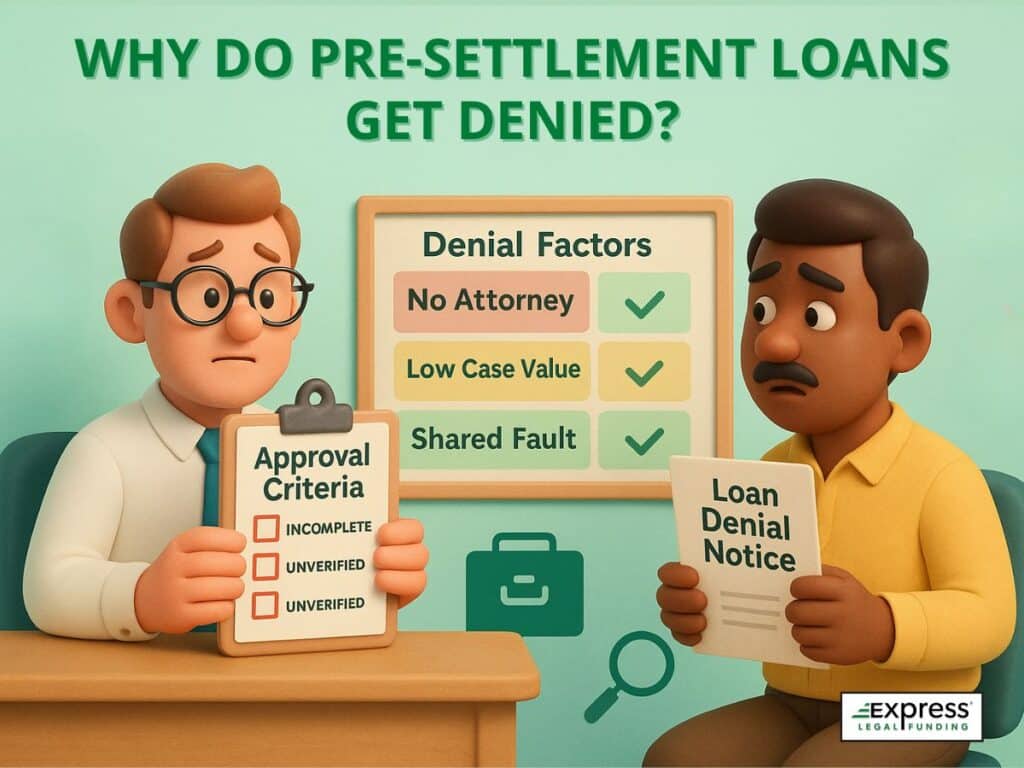
Legal funding companies will of course assess the risk very carefully before they’ll advance you a pre-settlement loan. The whole point is that you’re only repaying the loan out of a future settlement or court award so they have to be pretty confident that your case has a good chance of success and that the award (if successful) will be large enough to cover the loan amount, your attorney’s fees and any liens or medical bills you may have.
If your application has been rejected then it’s almost certainly down to your application not meeting the lender’s internal eligibility criteria or risk thresholds. That could be because of the stage of your case, the quality of the documentation you’ve provided or concerns around liability and potential recovery.
Here’s a list of the most common reasons that lawsuit loan applications are rejected.
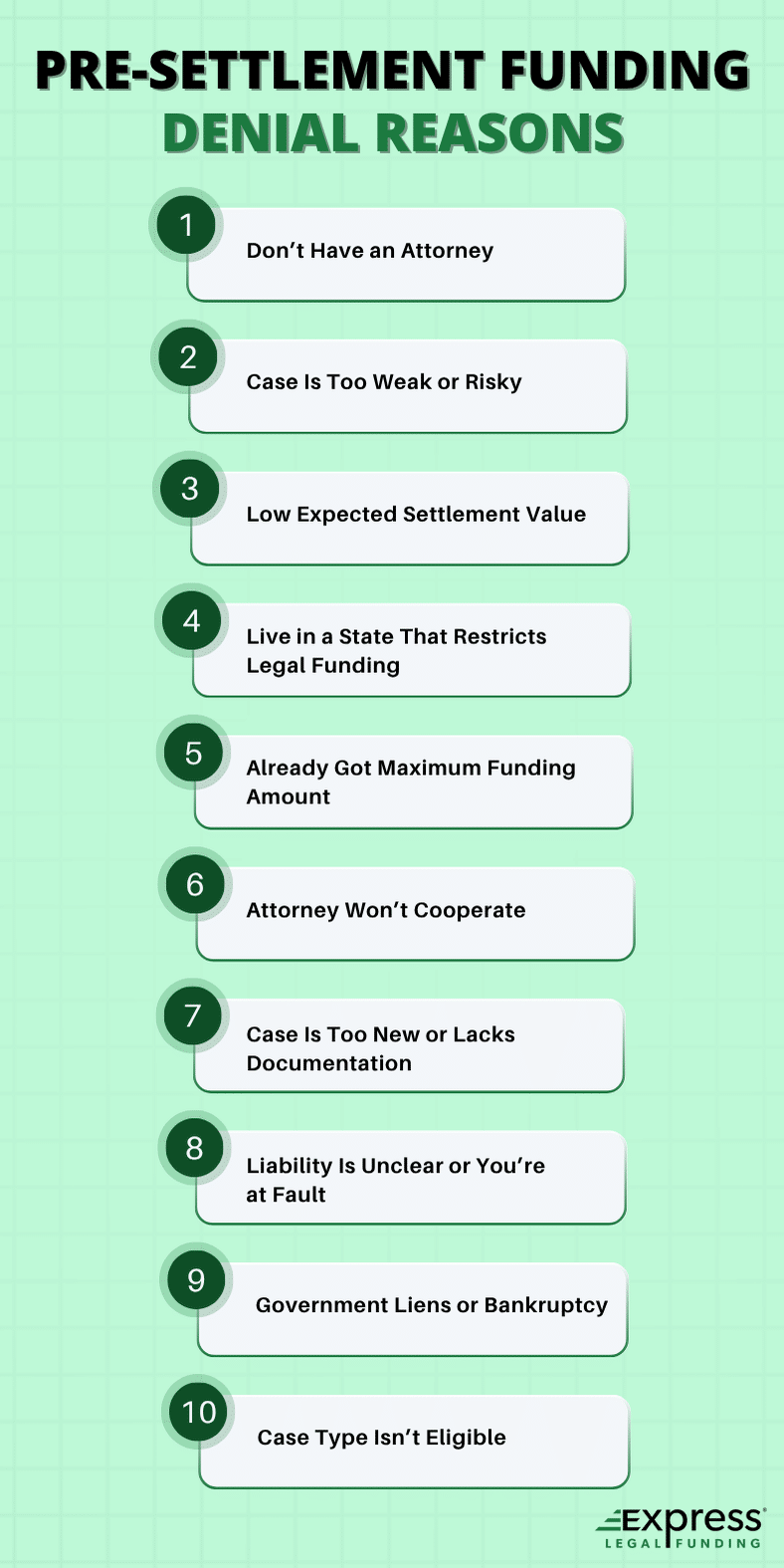
Top 10 Reasons Pre-Settlement Loans Are Denied
- You’ve got no attorney on your case.
- Your case is too weak or judged to be too risky by the funder.
- The expected settlement value is completely inadequate to justify any funding whatsoever.
- You live in a state that either restricts or bans legal funding.
- You’ve already received the maximum amount allowable under your case value.
- Your solicitor won’t be dealing with the funding company.
- Your case is too new or doesn’t have enough documentation.
- Liability is in dispute, or it’s unclear, or you’re in part at fault.
- You’ve got outstanding liens or you’re in an active bankruptcy.
- Your case type is either ineligible or goes against the lenders policy guidelines.
1. You Don’t Have an Attorney

Pre-settlement funders will reject applications from plaintiffs who don’t have an attorney. Legal representation is a strict requirement as the lenders depend on your lawyer to check the claim, keep them apprised of the progress of the case and to arrange any repayment from a future settlement. You simply can’t do it without a lawyer.
2. Your Case Is Too Weak or Risky
Lawsuit loan applications are very frequently rejected where the case is just too weak or too uncertain to win. The legal funding companies will look at the strength of your case in terms of the defendant’s liability, the evidence on hand and the likely damages. If it’s a case where there’s no real evidence and the chances of success are very slim then the funders won’t take that risk.
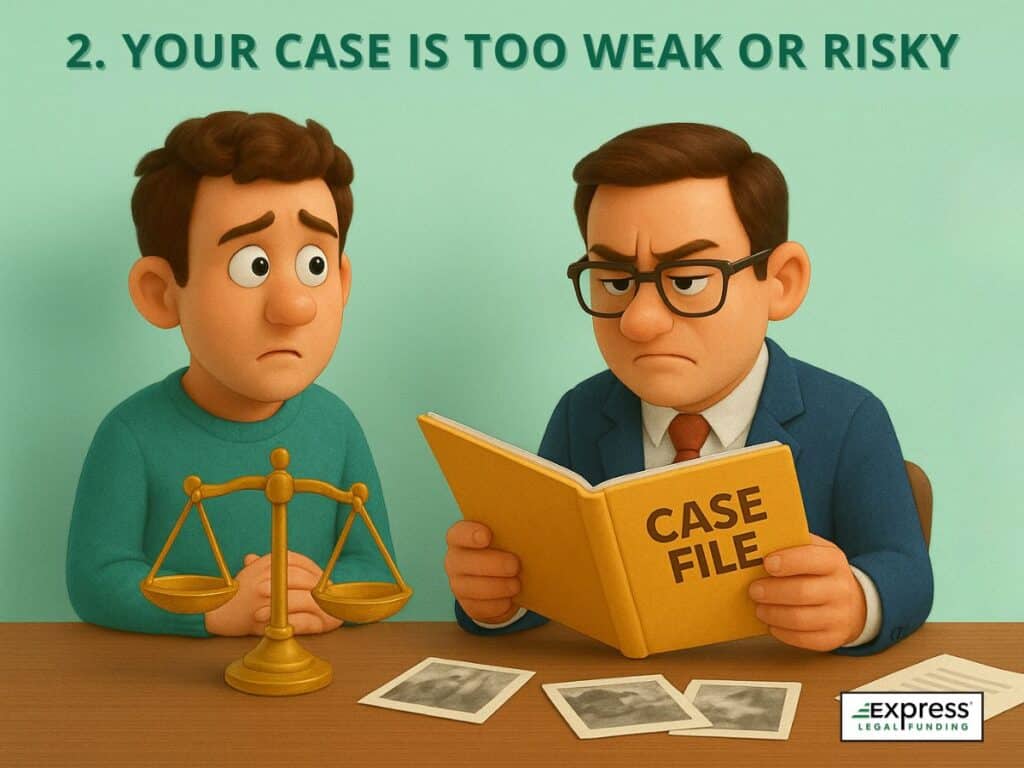
A slip and fall case is a perfect example of this. If there’s eyewitness evidence that the claimant in fact appeared to have deliberately fallen and there’s absolutely nothing visible on the floor in terms of any liquid or any other hazard at all then the credibility of the claim is going to be utterly destroyed.
Even if the plaintiff was injured the lack of liability evidence and the suggestion of fraud would probably be enough to cause funders to say no to the application.
3. Your Expected Settlement Value Is Too Low
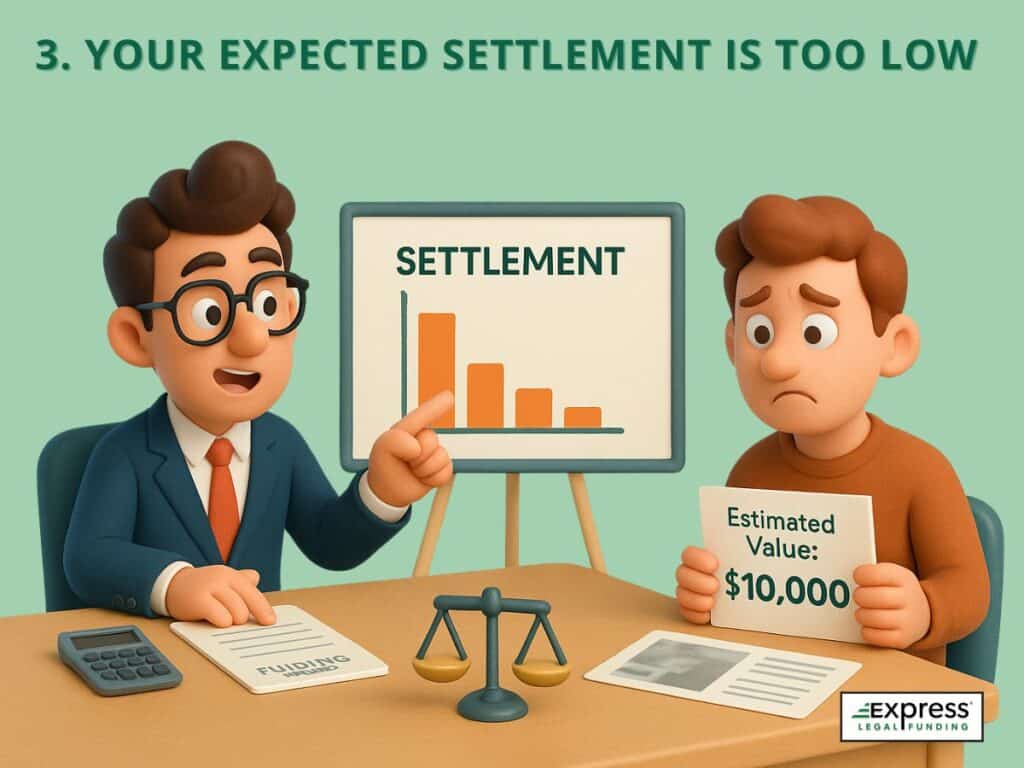
Pre-settlement loan applications are routinely rejected if the anticipated settlement is too low. Most of the legal funding companies will only fund cases which have a sufficient projected value (i.e. they’ll generally only fund cases which are worth $20k or over). There just isn’t enough in the case to fund the loan once the legal costs and liens have been paid. If your case is worth too little it won’t qualify.
4. You Live in a State That Restricts Legal Funding
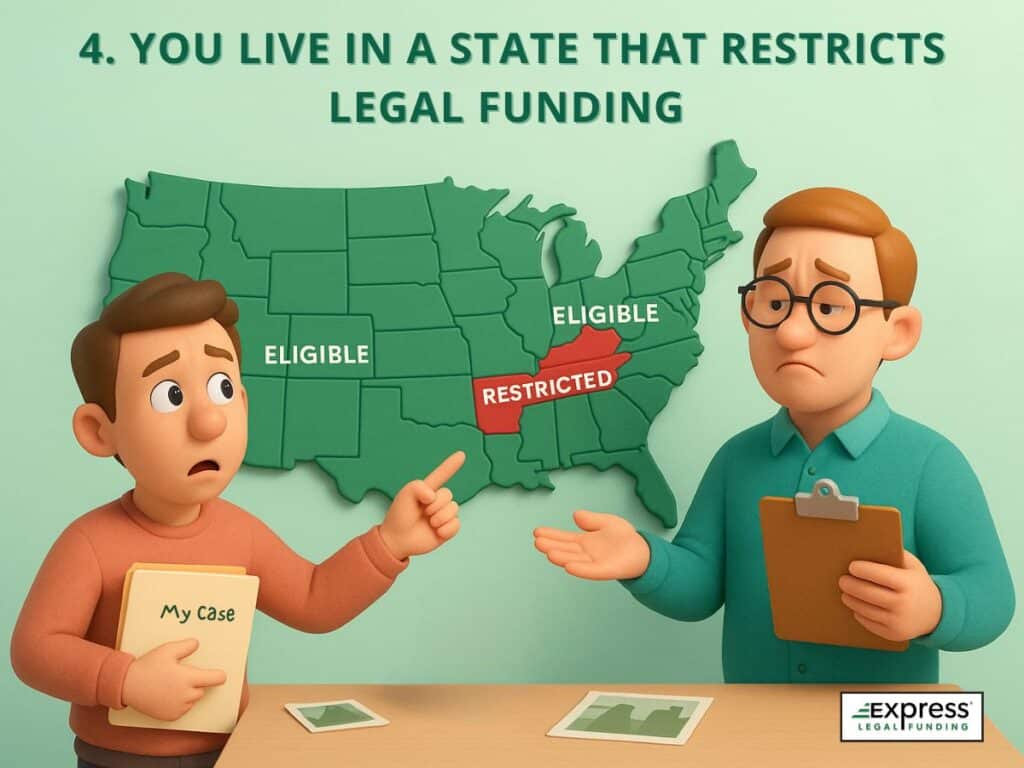
Some states will either ban or heavily regulate pre-settlement funding which will result in an automatic loan denial. If you’re in one of those states (Arkansas, Colorado, Kentucky or Tennessee for example) then lawsuit loans may not be available to you at all.
Even if your case is strong, ethical legal funding companies will not approve applications in jurisdictions where funding is not permitted.
5. You’ve Already Taken the Maximum Funding
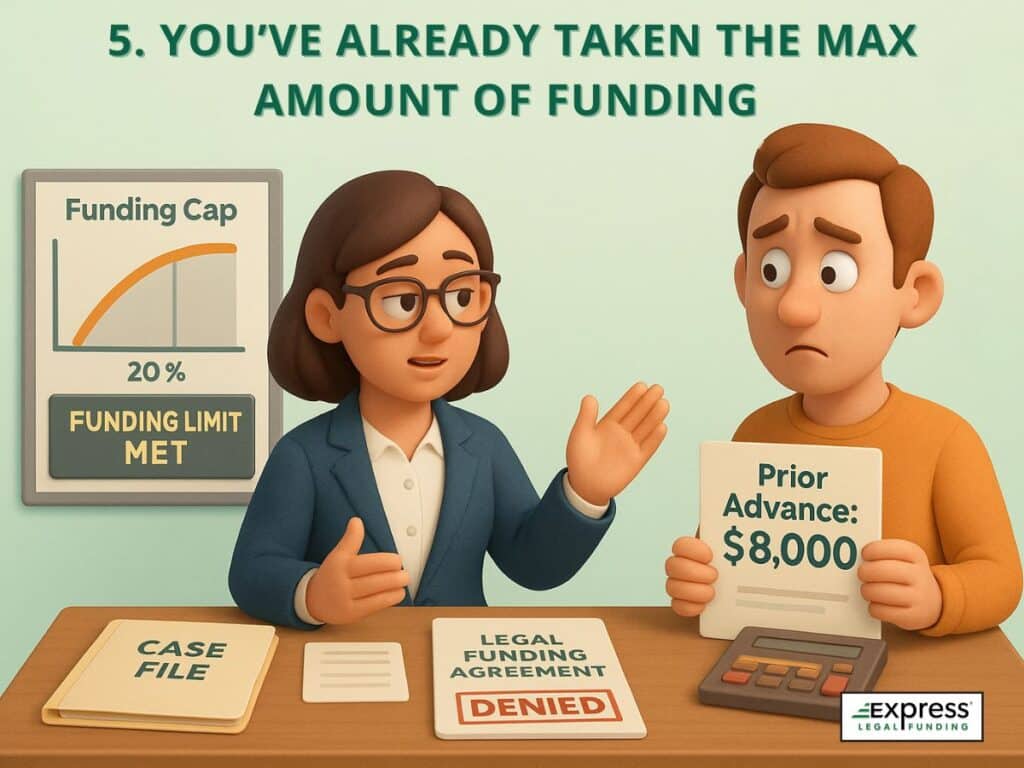
Lawsuit funding companies will generally cap their advances at 10% to 20% of the value of your case. If you’ve already had a prior pre-settlement loan or you’ve got any significant medical or legal liens you may well have hit your funding limit.
If there’s a new app in that scenario it’s very much likely to be rejected on the grounds that there’s virtually no recovery left.
Want to know if you can get any further funding? Have a read of our full guide: How many pre-settlement loans can you get?
6. Your Attorney Won’t Cooperate

If your lawyer is refusing to work with the funding company then your pre-settlement loan is very much going to be turned down. The legal funding companies will require your lawyer to provide the case documents, confirm the status of the case and sign the attorney acknowledgement section of the funding agreement. They simply won’t be in a position to process or approve the application without your lawyer.
Some lawyers will be reluctant to get involved in legal funding for one reason or another (concerns about the repayment terms, how it might affect the net settlement their client ultimately gets etc). This can take the form of them simply refusing to sign the funding agreement or of them just not sending the docs that are required. Even if your case is a qualifying one, a lack of co-operation from the lawyer can completely halt the process.
Pro tip: if that occurs then have an open chat with your lawyer to understand their concerns. Some funders are quite happy to work directly with your legal counsel to deal with the ethical or logistical issues.
Relevant guide: Can I get pre-settlement funding without my attorney’s consent?
7. Your Case Is Too New or Lacks Documentation
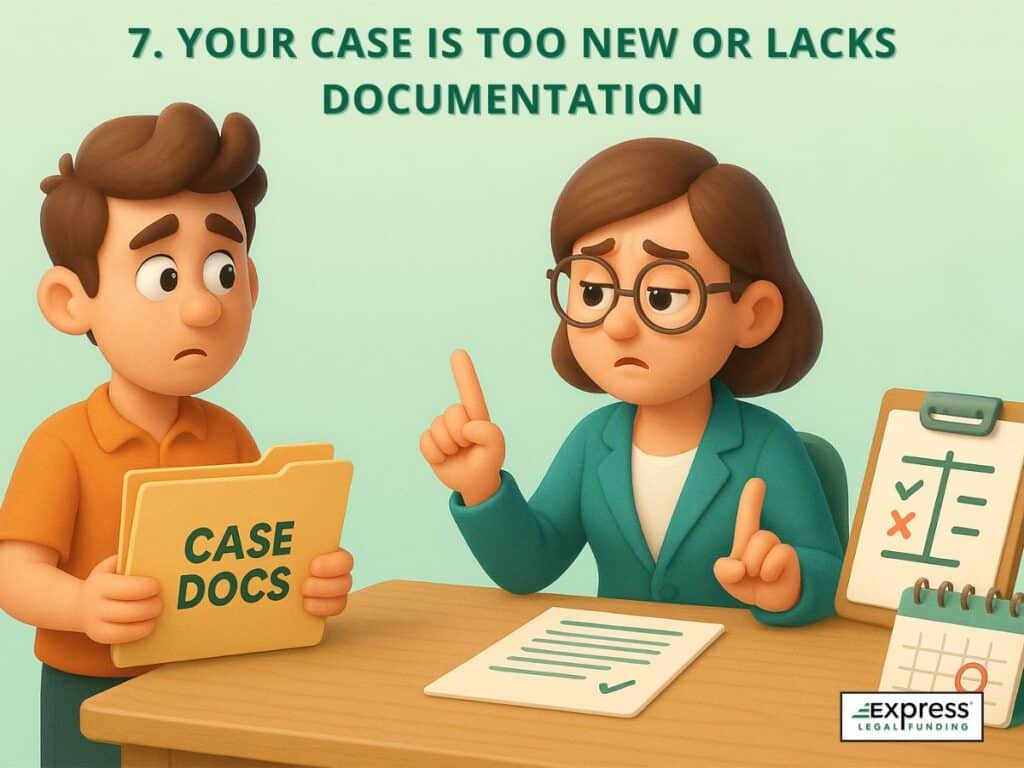
Pre-settlement loan applications are regularly rejected simply because there isn’t enough documentation to properly assess the case. The legal funding companies will look at the file to assess the risk and if there’s not enough in the file to properly assess the case they’re just going to say no.
If you’re still in the very early days of pre-litigation (i.e. you’re still waiting for the police report, the medical records, the witness statements, the formal complaint to be filed etc) then funders will very much be in the position of seeing your case as being too underdeveloped to fund. You may have sustained a very serious injury but the funder need to have the documentation in place to establish liability, the damage and the extent of the loss.
For example, if you’ve been injured in a rear end collision and you haven’t yet gone to the doctor or made a claim with the at fault driver’s insurer there’s no record of any damage or negligence. In that scenario the legal funding company will quite happily wait until they have more paperwork to go on before they’ll even look at your application.
Pro tip: the better your documentation (especially your medical records and incident reports) the easier it is for the underwriters to say yes to your request.
8. Liability Is Unclear or You’re Partially at Fault
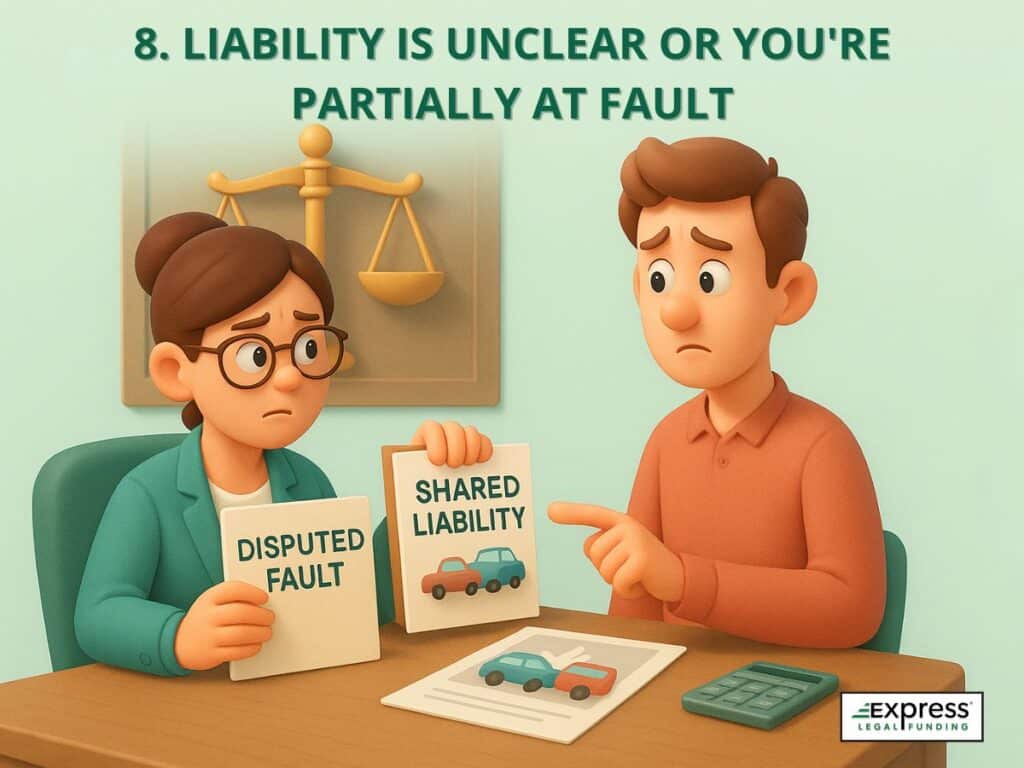
Legal funding companies will frequently turn down applications where there is some issue as to fault or where fault is shared. In the states that have comparative or contributory negligence, if you’re even a little bit at fault your settlement will be reduced or it could be completely wiped out. If there’s any doubt at all as to your liability then the funding company will almost certainly regard the case as too risky to fund.
For example, if you’d been injured in a slip and fall in a supermarket but there’s CCTV footage of you looking at your phone and not seeing a ‘Wet Floor’ notice (or indeed a witness says you deliberately slipped), the funds company could well be in a position to question the validity of your claim in terms of liability. Even if you were actually injured, that doubt as to whether you were at fault could result in the claim being rejected.
9. You Have Outstanding Liens or Bankruptcy
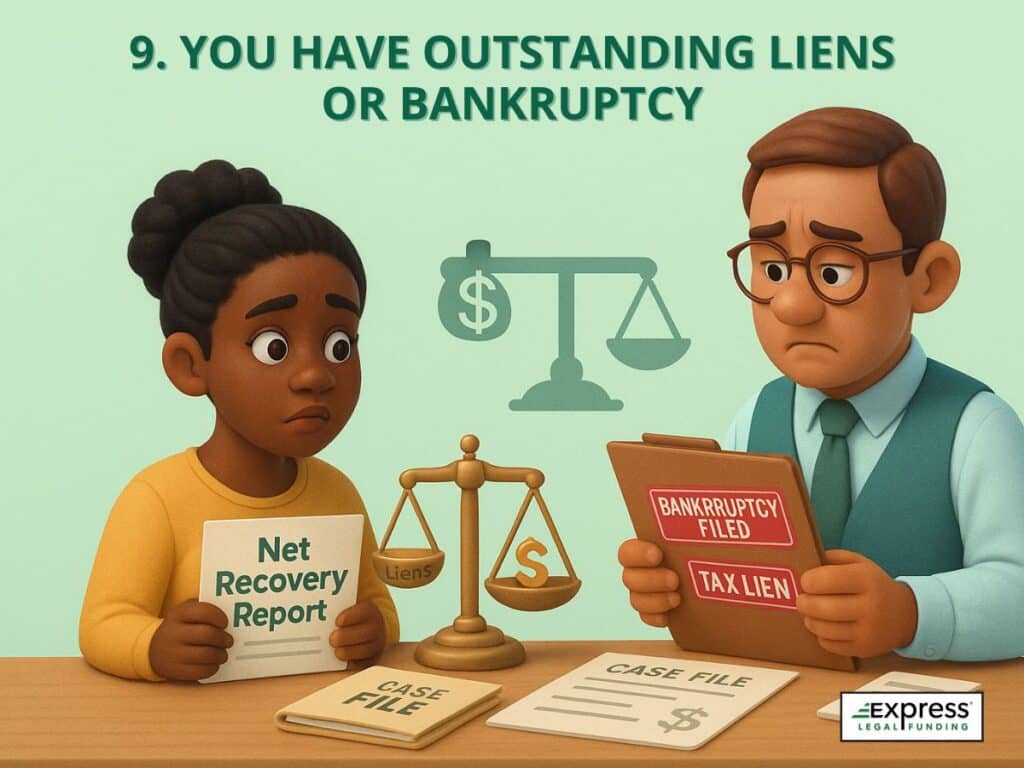
Pre-settlement loan applications can be rejected if you have a large number of liens or you’re in the middle of a bankruptcy. The legal funding companies will look at your net recovery (i.e. what’s left after you’ve deducted the attorney’s fees, your medical bills, any child support you owe, any tax liens etc). If those obligations are too high or there’s a bankruptcy court claim against your settlement they’ll probably say no.
10. Case Type Isn’t Eligible or Lender Policy Conflicts
Some legal funding companies will have restrictions as to the types of claims they’ll fund with a pre-settlement loan. A medical negligence claim, a workers’ comp claim or a complex class action may be outside the risk profile of a particular funder. Each funder has its own rules, so eligibility will vary from one funder to another.
Summary Table: Why Pre-Settlement Loans Get Denied
| Reason for Denial | Explanation |
|---|---|
| No Attorney Representation | Legal funding companies require you to have an attorney. Without legal representation, your application is automatically denied. |
| Case Is Too Weak or Risky | If your claim lacks evidence or has a low chance of winning, funding companies won’t take the risk. |
| Settlement Value Too Low | Cases valued under $20,000 may not qualify, as there may not be enough to cover the advance and legal costs. |
| State Restrictions on Legal Funding | States like Arkansas, Kentucky, and Tennessee limit or "ban" legal funding, leading to automatic denials. |
| You’ve Reached the Funding Limit | Funders typically cap loans at 10–20% of your case value. If you've already received funding, you may not be eligible for more. |
| Attorney Won’t Cooperate | If your lawyer refuses to share documents or sign the funding agreement, the application can’t proceed. |
| Case Is Too New or Missing Documentation | Early-stage claims without police reports or medical records are often denied due to lack of evaluable information. |
| Liability Is Disputed or Shared | If you’re partially at fault or liability is unclear, lenders may view your case as too risky. |
| Outstanding Liens or Bankruptcy | Active bankruptcy or unpaid liens (e.g., child support or tax debts) can reduce your net recovery and disqualify you. |
| Ineligible Case Type or Internal Policy | Some funders exclude case types like medical malpractice or workers’ comp. due to internal underwriting guidelines or restrictions from their financial backers. |
What to Do If Your Pre-Settlement Loan Is Denied (Step-by-Step Guide)
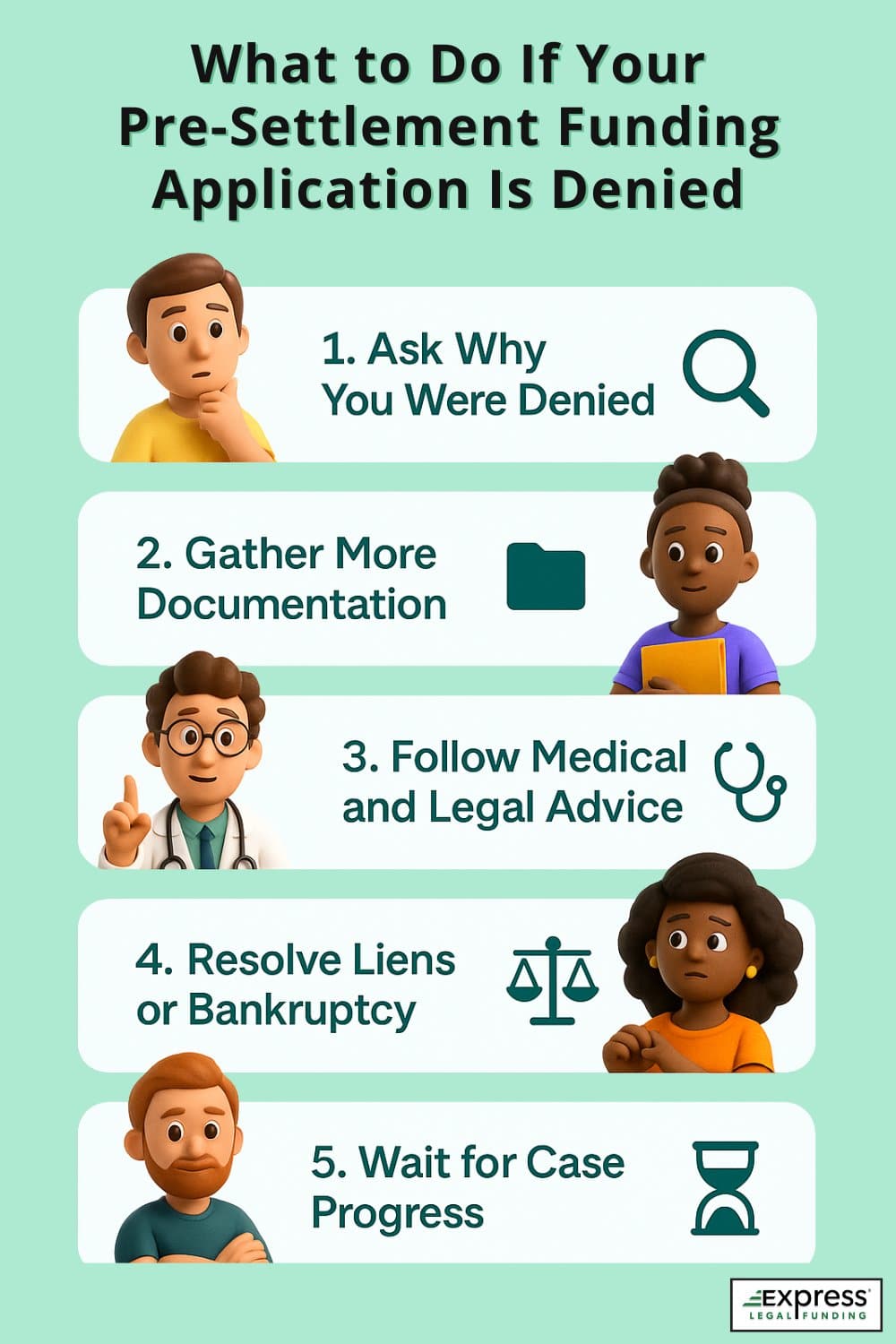
Denied a pre-settlement loan? This infographic sets out five sensible things to do next (from improving your documentation through to dealing with liens and simply waiting for your case to move on).
Getting turned down for a pre-settlement loan doesn’t necessarily mean you’re finished. In many instances the reason for the denial is something temporary such as missing documentation, the claim being in an early stage or the solicitor not having been fully co-operative. You can absolutely still get a pre-settlement loan approved on a subsequent application.
- Find out why you’ve been rejected (ask the funding company or your solicitor for a proper explanation). Once you know exactly why you’ve been turned down you can then take the appropriate action.
- Strengthen your case documentation by gathering all the relevant records you can. That would be medical reports, photos of the accident, police reports etc. The more evidence you have the better.
- Keep the medical treatment up and follow your lawyer’s advice. That’s the way to show you’re taking it seriously.
- Sort out any liens or legal issues. If you’ve got a child support lien, an IRS debt or you’re still in the midst of a bankruptcy for example then you need to get those sorted before you reapply. Liens and legal issues that aren’t resolved will reduce the amount you’re likely to get and will almost certainly result in another rejection.
- Wait until your case has progressed as there are occasions where time is the answer. Once your claim has progressed a bit further or you’re actually in the settlement process the lenders may well change their minds.
Pro tip: you can reapply with the same lender or indeed go and apply with another one that may have more relaxed criteria.
🟢 Apply for a pre-settlement advance with Express Legal Funding. Approvals are quick!
Best Alternatives to Pre-Settlement Loans After a Denial
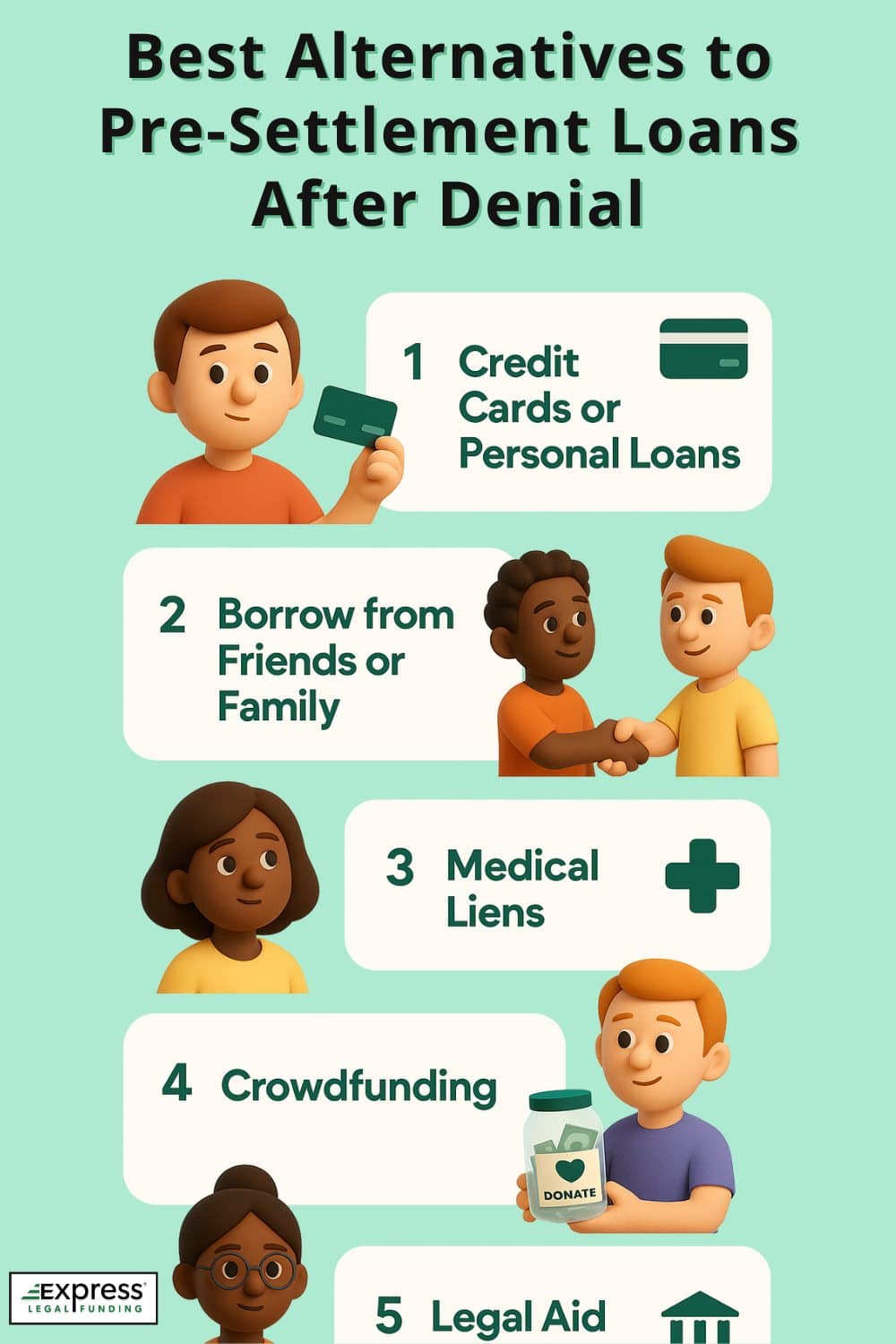
If your lawsuit loan application is turned down there are still other ways of getting some financial support whilst your case is pending. The following are some alternative funding options to consider:
- Personal loans or credit cards – those give you the cash immediately but you’ve got the obligation to repay it plus interest. They’re very different to non-recourse legal funding.
- Borrow from friends or family (not really the ideal solution in most cases but can be a way of getting the cash without having to go through the formality of a loan).
- Medical provider liens/treatment on contingency: Some medical providers will be prepared to put a lien on their treatment until your case settles via a Letter of Protection (LOP). That’s a legal agreement which effectively says they’ll be paid out of your future settlement and is very common in the personal injury field.
- Crowdfunding sites (e.g. GoFundMe) enable you to raise money from your community to help with your bills and living expenses.
- Legal aid or via local non-profits – depending on your circumstances you may be eligible for emergency financial assistance or legal aid through a non-profit organisation.
Pro tip: all of these alternatives will give you some short term relief, just always get your solicitor’s advice before you make any financial decisions in relation to your claim.
Explore your alternative financial options further in our guide: 15 Alternatives to Lawsuit Loans: Pros, Cons & How to Apply
Pre-Settlement Loan Denial FAQs: Common Questions Answered
No, you have to have an attorney in order to qualify for a pre-settlement loan. The legal funding companies will require an attorney to validate your case, to provide the documentation and to be the one who is actually going to be collecting the money from your settlement. Any application that doesn’t have an attorney is automatically rejected
No, your credit score in any way affects your eligibility for legal funding. Pre-settlement loans are purely based on the strength and value of your case. Your credit history, income and employment status are irrelevant.
Yes, you can reapply after a denial (particularly if you’ve addressed the issue that led to the denial). Common reasons for reapplying would be additional documentation, case progress or attorney co-operation. Some lenders will actually encourage you to reapply once your case has matured.
You can reapply for legal funding at any time once your case status has changed or the reason for the denial has been resolved. This could be as a result of completing your medical treatment, producing more documentation or obtaining the attorney’s agreement. Some plaintiffs will reapply in a matter of weeks, others will wait until their case has moved on considerably.
At Express Legal Funding we’ll often encourage people to reapply in 30 days if their original application was turned down on grounds of timing (i.e. the case was too fresh, or there wasn’t enough documentation). We find that a large number of people who were previously declined will in fact be approved by our underwriters on a reapplication, either because more information has come to light or the case has progressed.
Yes, you can apply with a different legal funding company if you’ve been turned down by one. Each company will have their own underwriting criteria, their own case type preferences and their own risk appetite. One lender turning you down doesn’t necessarily mean that another won’t. It’s very much possible that another company will approve your application, particularly if your case has developed or you’ve got some additional documentation to submit. Always get your solicitor’s view before you switch.
Your solicitor can’t stop you applying for a lawsuit loan, they can just prevent it from being approved by not co-operating. The legal funding companies need your solicitor to sign off on the paperwork and to confirm the details of the case. If your solicitor won’t co-operate then your application won’t get anywhere.
Relevant guide: Can my lawyer stop me from getting pre-settlement funding?
Final Thoughts: Don’t Give Up After Denial. You May Still Qualify for Legal Funding
Getting turned down for a pre-settlement loan can be extremely frustrating but it doesn’t in any way mean that your case is a bad one. The vast majority of the time the reason for a refusal will be to do with timing, the documentation or the eligibility criteria rather than the case per se. If you know why you’ve been turned down you may well be able to secure the funding you’re after at a later stage.
Legal funding companies will of course do a full risk assessment but many will do a second review once your case has progressed.
Need a Second Opinion? Express Legal Funding Can Help
If another legal funding company have turned down your application for a pre-settlement loan then by no means should you give up. At Express Legal Funding we specialise in getting plaintiffs approved (we’ve had cases where other lenders have said no and we’ve still got them approved) with fast pre-settlement funding buyouts. We look at each case in a different way and we’ll never charge you a fee to apply or to look at your claim.
We’ve helped thousands of injured clients get fast, cheap pre-settlement cash advances. We’ve done it in the most difficult of circumstances.
Contact us today for a free, no-obligation case evaluation, and see how much funding you could qualify for based on your updated case status.
Apply for a Pre-Settlement Loan With Express Legal Funding
Glossary of Key Terms in This Article
- Pre-settlement loan (also called lawsuit funding, legal funding, or a lawsuit cash advance): A type of financial advance offered to plaintiffs involved in active legal claims. It’s based on the anticipated value of a future settlement or court award and does not require repayment unless the plaintiff wins the case.
- Non-recourse: A funding arrangement where repayment is only required if the plaintiff successfully recovers compensation. If the case is lost, the plaintiff owes nothing back.
- Plaintiff: The individual or party who files a lawsuit, seeking compensation or relief from the opposing party.
- Settlement: A mutual agreement reached between both sides in a legal dispute, often resolving the matter without going to trial.
- Court award: A sum of money granted to the plaintiff by a judge or jury following a trial verdict.
- Legal representation: The act of being represented by an attorney during a legal matter.
- Liability: Legal accountability for causing harm, injury, or damage to another party.
- Damages: The monetary compensation sought or awarded to a plaintiff for losses or injuries suffered.
- Expected settlement value: The projected amount of money a case is likely to resolve for, typically estimated by attorneys or funding companies.
- Funding cap: The upper limit on how much pre-settlement funding a company will provide for a case, generally expressed as a percentage of the estimated settlement amount.
- Attorney acknowledgement: A part of the funding agreement that requires the plaintiff’s attorney to confirm case details and agree to cooperate with the funding provider.
- Documentation: All relevant materials used to support a legal case, including police reports, medical records, witness statements, and photographs.
- Pre-litigation: The phase before a lawsuit is officially filed in court, where parties may negotiate or prepare their case.
- Comparative negligence: A legal concept where the plaintiff’s compensation may be reduced based on their share of fault in the incident.
- Contributory negligence: A more rigid legal rule (used in some states) where if the plaintiff is found to be even slightly at fault, they may be denied any compensation.
- Lien: A legal claim placed on a plaintiff’s future settlement or court award to ensure repayment of debts like medical bills, taxes, or child support.
- Bankruptcy: A legal procedure for individuals or businesses who can’t repay debts. An ongoing bankruptcy case can impact a plaintiff’s eligibility for pre-settlement funding.
- Underwriting criteria: The set of rules and risk factors a legal funding company uses to assess whether to approve a funding application.