
One day you were working and getting paid. The next, an injury left you unable to work, and the paycheck you relied on for rent, groceries, utilities, and transportation suddenly stopped. If you’re wondering how to pay bills after an injury, you’re not alone—losing your income, even for a short time, can create immediate financial pressure.
The bills do not pause because you were injured, and an insurance claim or lawsuit may take months to resolve. Fortunately, you may have several options, including insurance benefits, workers’ compensation, disability coverage, emergency assistance, and pre-settlement funding.
Pre-settlement funding provides immediate cash based on an expected recovery from a pending injury claim. It is generally structured as a non-recourse advance rather than a traditional loan, although its legal classification and the rules governing it vary by state.
This article explains what to try first, how funding works, what it may cost, and how to decide whether it makes sense for your situation.
Key Takeaways
- If an injury stops your income, first check for workers’ compensation, disability insurance, auto insurance coverage, employer benefits, and emergency assistance.
- Pre-settlement funding may provide cash based on an expected injury recovery when other benefits are unavailable or insufficient.
- Funding is generally non-recourse, meaning repayment comes from the recovery and ordinarily is not owed if the case produces no recovery, provided you comply with the agreement.
- Pre-settlement funding is not technically wage replacement. It is funding based on a legal claim that may be used for living expenses while your income is interrupted.
- Funding fees reduce what you ultimately receive, so request written payoff examples and take only what you reasonably need.
What Should I Do First When My Income Stops After an Injury?
Before applying for pre-settlement funding, look for benefits or assistance that may provide money without reducing your future injury recovery.
Ask About Workers’ Compensation Benefits

If the injury happened while you were performing job duties, you may qualify for workers’ compensation benefits. Depending on your state and circumstances, workers’ compensation may provide medical treatment, partial wage replacement, rehabilitation, and other benefits.
Workers’ compensation programs and eligibility rules vary by state. The U.S. Department of Labor also administers separate programs for certain federal employees and other covered groups that provide benefits such as wage replacement and medical care.
Report the injury promptly and ask your employer, claims administrator, or workers’ compensation attorney which benefits may apply.
Review Your Auto Insurance Coverage
If you were injured in a motor vehicle accident, review your auto insurance policy for Personal Injury Protection, medical-payments coverage, or other first-party benefits.
Personal Injury Protection, commonly called PIP, may cover medical expenses and lost wages in some states, subject to policy limits and coverage terms. Availability and benefits depend on state law and the specific policy.
You may also have uninsured or underinsured motorist coverage if the responsible driver had no insurance or insufficient coverage.
Check Employer Disability Benefits, Sick Leave, and PTO
Contact your employer or human resources department to determine whether you have:
- Accrued paid sick leave
- Paid time off
- Short-term disability insurance
- Long-term disability insurance
- Salary-continuation benefits
- An employee emergency-assistance program
Disability insurance may replace part of your income for a qualifying period, but waiting periods, benefit percentages, exclusions, and maximum payments vary by plan.
Check State Disability Programs
Several states provide temporary disability or paid medical-leave benefits for eligible workers who cannot work because of a non-work-related injury or medical condition.
These programs are not available everywhere, and eligibility depends on factors such as employment history, wages, disability duration, and the reason you cannot work. Check your state labor, disability, or workforce agency for current requirements.
Consider Social Security Disability Benefits
If your condition is expected to prevent substantial work for at least 12 months or result in death, you may qualify for Social Security Disability Insurance or Supplemental Security Income.
Social Security Disability Insurance generally requires sufficient recent work history in addition to meeting the Social Security Administration’s disability standard. SSDI also usually has a five-month waiting period before benefit payments begin, so it may not solve an immediate short-term cash shortage.
Relevant read: How Long Can I Work on Social Security Disability Insurance?
Look for Household and Community Resources
A spouse or household member may have insurance, leave, or employee-assistance benefits that can help with shared expenses. You may also qualify for food assistance, utility relief, rental assistance, transportation support, or medical-cost programs.
Calling 211 may connect you with local emergency services, community organizations, food programs, housing assistance, and other resources available in your area.
Contact Creditors Before Missing Payments

Call your landlord, mortgage servicer, utility providers, auto lender, credit-card companies, and medical providers as soon as you know you may fall behind.
Ask whether they offer:
- Temporary hardship plans
- Payment extensions
- Reduced-payment arrangements
- Interest or late-fee waivers
- Medical-bill payment plans
- Utility shutoff protections
- Mortgage or rental assistance
Reaching out before an account becomes seriously delinquent generally gives you more options than waiting until several payments have been missed.
Tell Your Personal Injury Attorney
Let your attorney know that your income has stopped and your bills are becoming difficult to manage. Your lawyer may be able to identify available insurance benefits, explain how your claim is progressing, and help you evaluate whether a funding request is reasonable.
Your attorney will also be involved if you apply for pre-settlement funding because the funding company typically needs case information directly from the law firm.
Can Pre-Settlement Funding Help While I Am Out of Work?

Sometimes. If you’re struggling to pay bills after an injury, pre-settlement funding may help if you have a qualifying personal injury claim, an attorney representing you, and an expected settlement or judgment that can reasonably support an advance. Whether you qualify depends on the strength of your case and other factors reviewed during the funding process.
Funding may be used for rent, groceries, utilities, transportation, insurance premiums, medical expenses, or other daily needs while the claim remains unresolved.
However, it is important to understand that pre-settlement funding does not replace your wages in the same way that workers’ compensation, disability insurance, paid leave, or PIP benefits might. It provides money based on your pending legal claim, and the agreed repayment amount is deducted from a successful recovery.
When Pre-Settlement Funding May Help
Funding may be worth considering when:
- You have a pending injury claim with an attorney.
- Your wages or self-employment income have stopped or fallen significantly.
- Available insurance and disability benefits do not cover your essential expenses.
- You have already explored lower-cost assistance.
- Your expected recovery can reasonably support an advance.
- The amount requested is limited to what you need.
Funding may reduce the immediate financial pressure to accept an inadequate settlement simply because you cannot keep up with basic bills.
When Pre-Settlement Funding May Not Be the Best Option
Funding may not be appropriate when:
- You do not have a qualifying legal claim.
- You do not have an attorney.
- Liability or insurance coverage remains too uncertain.
- The case is too early to estimate its value.
- Existing liens and expenses leave little expected net recovery.
- The amount you need is more than the claim can support.
- Insurance benefits or assistance programs would cover the expense without reducing your settlement.
- Your state, claim type, or circumstances are not eligible.
Approval is never guaranteed, and funding should not be treated as a substitute for wages, insurance, or long-term disability support.
Do I Have to Repay the Pre-Settlement Funding if I Lose?

Pre-settlement funding is generally non-recourse. That means repayment ordinarily comes from the proceeds of your injury claim rather than from your wages, bank account, or personal assets.
If your case produces no settlement or award, you generally owe nothing, provided you comply with the funding agreement. Contracts may include exceptions involving fraud, material misrepresentation, duplicate funding, failure to cooperate, or another contractual breach.
You also do not normally make scheduled monthly payments while the case is pending. If the case produces a recovery, your attorney generally pays the agreed amount from the settlement before distributing the remaining proceeds.
Terms and legal classifications vary by state, so read the agreement carefully and have your attorney review it before signing.
Why Is My Settlement Taking So Long When My Bills Are Due Now?

An injury claim may take many months or longer to resolve, even when the claimant’s financial needs are immediate.
The Insurance Investigation Is Ongoing
The insurance company may need to review accident reports, medical records, witness statements, photographs, employment records, expert opinions, and other evidence before evaluating the claim.
Insurance investigations and negotiations take time. As the wait continues, financial pressure may make a lower, faster settlement feel more attractive to an injured claimant.
Liability Is Disputed
The parties may disagree about who caused the accident or whether the injured person shares responsibility.
Your attorney may need additional evidence such as surveillance video, vehicle data, expert analysis, witness testimony, or accident-reconstruction reports.
Your Injuries Are Still Being Evaluated
Settling before your medical condition is reasonably clear could leave you without adequate compensation for future treatment, permanent limitations, reduced earning capacity, or complications that have not yet been diagnosed.
Your attorney may recommend waiting until your doctors can better evaluate your prognosis and future medical needs.
The Value of the Claim Is Disputed
The insurer may challenge whether treatment was necessary, whether all injuries were caused by the accident, how much income was lost, or what future care will cost.
If the parties cannot agree, the attorney may need to file a lawsuit and proceed through discovery, depositions, mediation, motions, or trial preparation.
Can I Get Pre-Settlement Funding if the Injury Happened at Work?

Possibly, but workplace injury cases require careful review. Workers’ compensation claims and third-party liability claims are handled differently, which can affect eligibility for pre-settlement funding.
Workers’ compensation generally provides statutory benefits for employees injured during their employment. Those benefits may include wage replacement and medical treatment, but workers’ compensation laws and benefit structures vary by state.
In many situations, workers cannot bring an ordinary personal injury lawsuit against their employer for a covered workplace injury. However, an injured worker may have a separate third-party claim if someone other than the employer caused or contributed to the accident.
For example, a third-party claim may arise when an injury involves:
- A negligent driver
- A defective machine or tool
- A dangerous product
- A property owner
- A subcontractor
- Another company working at the jobsite
Third-party claims are generally evaluated more like traditional personal injury cases and may be more suitable for non-recourse funding.
Ask your workers’ compensation or personal injury attorney what type of claim you have and whether funding is legally and financially appropriate.
What Does a Pre-Settlement Funding Company Consider?

Approval is primarily based on the legal claim rather than the applicant’s employment income or traditional credit score.
A funder may evaluate:
- The evidence of liability
- The severity and documentation of the injuries
- Available insurance coverage
- Medical treatment
- The stage of the claim
- Expected settlement or judgment value
- Attorney’s fees
- Medical liens
- Health-insurance reimbursement claims
- Existing funding advances
- Workers’ compensation liens
- Other claims against the recovery
- The applicant’s expected net proceeds
Express Legal Funding does not require a hard credit check. Approval is primarily based on the strength and expected value of the legal claim rather than the applicant’s credit score or current employment income.
How Do I Apply for Pre-Settlement Funding?
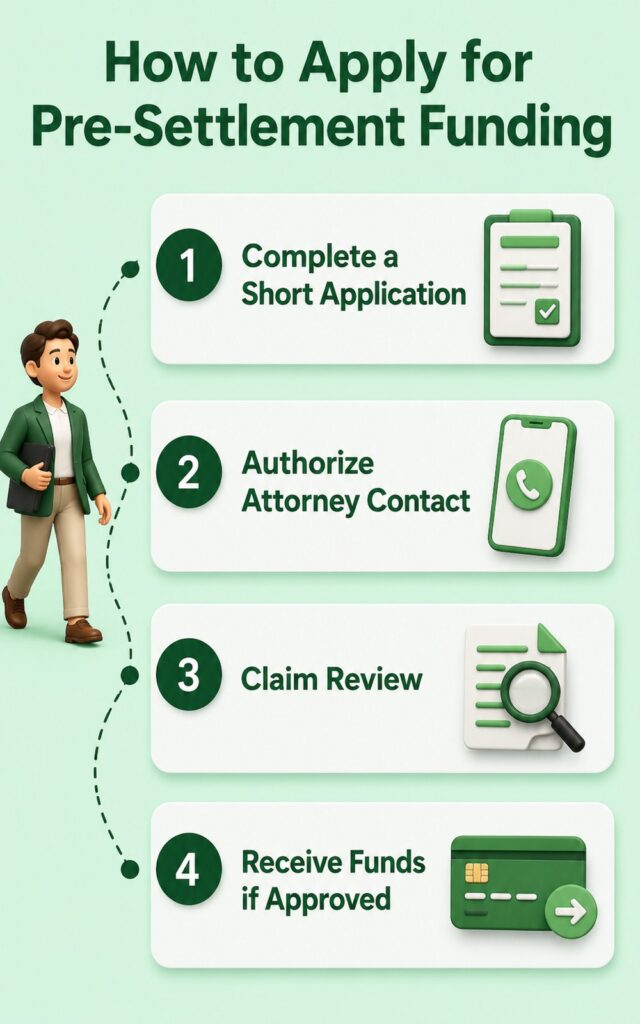
The application process generally includes four stages.
Complete a Short Application
Provide your name, contact information, attorney’s details, and basic information about the accident and injuries.
Express Legal Funding does not require a hard credit check when reviewing a pre-settlement funding application.
Authorize the Funding Company to Contact Your Attorney
The company requests case information from your attorney or law firm. You usually do not need to collect all medical records and legal documents yourself.
Wait for the Claim Review
The funder evaluates liability, insurance coverage, injury documentation, case status, liens, and expected net recovery.
The speed of the review depends partly on how quickly the attorney provides the requested information.
Review the Offer and Receive the Funds
If approved, review the amount, pricing, fees, payoff examples, non-recourse provisions, and all contractual obligations before signing.
After the agreement is completed, the funds may be issued by check, electronic transfer, wire, or another available payment method. Timing varies based on underwriting, attorney responsiveness, document completion, and the payment method selected.
How Much Money Can I Get?
The amount of pre-settlement funding you may be eligible for depends on the estimated value and expected net proceeds of the claim. A funder will not base the decision only on the seriousness of the injury or the claimant’s immediate financial need.
The company may consider available insurance, disputed liability, attorney’s fees, medical expenses, liens, existing advances, and other obligations that must be paid from the recovery.
You do not have to accept the maximum amount offered. Requesting only what you reasonably need can help preserve more of the final settlement and reduce the amount repaid.
Taking several advances can also increase the total cost, so discuss the cumulative impact with your attorney before requesting additional funding.
What Are My Other Options Besides Pre-Settlement Funding?
The following comparison can help you evaluate potential sources of assistance.
| Option | Hard Credit Check? | Monthly Repayment? | Cost or Limitation | May Be Useful For |
|---|---|---|---|---|
| Workers’ compensation wage benefits | No | No | No repayment required; eligibility and benefit limits apply | Qualifying work-related injuries |
| PIP or auto insurance wage coverage | No | No | No repayment, but policy limits and coverage terms apply | Qualifying motor vehicle injuries |
| Employer disability insurance | No | No | Waiting periods, percentages, and plan limits may apply | Employees with short- or long-term disability coverage |
| Paid sick leave or PTO | No | No | Limited to accrued or available leave | Shorter periods away from work |
| State disability benefits | No | No | Available only in certain states and subject to eligibility | Qualifying non-work-related disabilities |
| SSDI or SSI | No | No | Strict disability requirements and possible waiting periods | Qualifying long-term disabilities |
| Community or nonprofit assistance | No | No | Availability and eligibility vary | Food, housing, transportation, and utilities |
| Family or friends | No | Varies | May create financial or relationship pressure | Smaller short-term needs |
| Credit card | Usually | Yes | Interest, minimum payments, and potential credit effects | Short-term costs that can be repaid quickly |
| Pre-settlement funding | Express Legal Funding does not require a hard credit check | No scheduled monthly payments | Fees reduce a successful recovery | Essential expenses when other resources are insufficient |
Workers’ compensation, insurance benefits, paid leave, disability coverage, and emergency assistance are usually worth exploring first because they may not require repayment from your injury recovery.
What Will Legal Funding Cost, and What Should I Ask Before Signing?

The total cost depends on the provider, amount funded, pricing method, and time required to resolve the claim. Pre-settlement funding costs may increase over time, remain fixed for defined periods, or be capped, depending on the agreement.
“What Will I Owe at Different Settlement Dates?”
Ask for exact written payoff examples showing what you would owe if the case resolves in six, 12, 18, or 24 months. Written examples are more useful than relying only on an advertised rate or verbal explanation because they show the actual amount that may be deducted from your recovery.
“Does the Cost Grow Continuously or by Fixed Periods?”
Some agreements increase the repayment balance monthly, while others use fixed six-month periods, tiers, or another structure. Ask when each increase occurs, whether charges apply to the original amount or an accumulated balance, and what happens if the case settles shortly after a new pricing period begins.
“Is the Repayment Amount Capped?”
A repayment cap limits the maximum amount due even if the case takes longer than expected. Ask whether the agreement includes a cap, how the cap is calculated, and whether fees or delivery charges sit outside that maximum.
“Are There Additional Fees?”
Request a written list of all application, underwriting, origination, processing, administrative, delivery, wire, broker, referral, or document fees. Confirm whether those charges are deducted from the amount you receive or added to the amount repaid from the settlement.
“What Happens if the Recovery Is Smaller Than Expected?”
Ask how the company handles a settlement that is lower than originally projected. Review whether the agreement permits a reduction, requires negotiation among the attorney and lienholders, or gives the funder any particular rights when the available proceeds are insufficient to pay every obligation in full.
“How Much Will Likely Remain From My Settlement?”
Your attorney can help estimate the amount remaining after attorney’s fees, litigation expenses, medical liens, health-insurance reimbursement claims, workers’ compensation liens, existing funding balances, and other obligations. The estimate may change, but it can help you avoid accepting an advance that consumes too much of your expected net recovery.
“What Happens if the Case Produces No Recovery?”
Read the non-recourse language and all exceptions carefully. Repayment ordinarily is not required if the claim produces no recovery, provided you complied with the agreement, but contractual exceptions may apply to fraud, material misrepresentation, duplicate funding, or other breaches.
“Can the Funding Company Influence My Case?”
The funder should not direct your attorney, control legal strategy, or decide whether you accept a settlement. Those decisions remain with you and your attorney, so review any provisions involving settlement notices, consultations, or payment instructions before signing.
How Do I Choose a Company I Can Trust?
When your income has stopped, the urgency of your situation can make the first available offer seem attractive. Compare the complete terms and the company’s practices rather than choosing based only on speed or the amount offered.
Determine Whether It Is a Direct Funder or Broker
A direct funder provides the money itself and makes its own funding decision. A broker collects the application and refers it to one or more funding companies.
Neither structure automatically guarantees better pricing. Ask whether any broker, referral, administrative, or third-party fees apply and who will own the funding agreement after you sign.
Relevant guide: Legal Funding Brokers vs Lawsuit Loan Company: How to Choose?
Compare Total Repayment, Not Only the Advertised Rate
A low advertised rate may not reflect compounding, fixed-period increases, application fees, delivery charges, or other costs.
Request written payoff examples from every company based on the same funding amount and settlement dates. Comparing the actual dollar amounts owed at six, 12, 18, and 24 months provides a more meaningful comparison.
Get Every Fee in Writing
The agreement should clearly identify the advance amount, pricing method, fees, repayment examples, and any maximum repayment amount.
Be cautious if the company refuses to provide written examples, pressures you to rely on a telephone explanation, or changes the offer shortly before signing.
Review the Non-Recourse Terms
Confirm that repayment ordinarily comes only from a successful claim recovery. Read all exceptions involving fraud, misrepresentation, cooperation, duplicate funding, case dismissal, attorney changes, and other contractual duties.
Ask your attorney to explain any language you do not understand before accepting the funds.
Confirm That the Company Respects Your Attorney’s Role
The funder should communicate professionally with the law firm without attempting to control the claim.
It should not pressure your attorney to settle, demand authority over legal strategy, or interfere with your decision to accept or reject an offer. The company’s role is to evaluate and fund the claim, not manage the lawsuit.
Ask How Quickly Payoff Information Is Provided
Your attorney will eventually need an accurate payoff statement before distributing settlement proceeds.
Ask how payoff statements are requested, how quickly the company provides them, whether there is a charge, and whom the law firm should contact if questions arise.
Check Licensing and State Compliance
Funding laws differ by state. Some jurisdictions require registration or licensing, while others regulate disclosures, fees, contract language, rescission rights, or attorney acknowledgments.
Ask whether the company is authorized to provide the product in your state and whether the agreement follows applicable requirements. Express Legal Funding publishes information about its state licensing and regulatory compliance.
Review Customer Feedback Carefully
Read reviews across more than one platform and look for patterns rather than relying on a single complaint or testimonial.
Pay attention to comments involving:
- Pricing transparency
- Payoff statements
- Attorney communication
- Funding speed
- Customer service
- Unexpected fees
- Aggressive sales pressure
- Difficulty resolving errors
Better Business Bureau information and independent reviews may provide useful context, but they should not replace reading the agreement yourself.
Avoid Pressure to Take More Than You Need
A reputable provider should not pressure you to accept the maximum amount available.
The company should explain that every advance reduces the claimant’s eventual net recovery. Taking the smallest amount that reasonably addresses the immediate need usually protects more of the settlement.
Relevant read: How to Choose a Trustworthy Legal Funding Company?
Why Choose Express Legal Funding When Your Income Has Stopped?
Express Legal Funding is a direct funder, so applicants work with the company reviewing and funding their claims rather than an outside broker.
The company evaluates applications primarily on the strength and expected value of the pending legal claim. Express Legal Funding does not require a credit check or scheduled monthly payments for its typical non-recourse pre-settlement funding products.
Our team coordinates directly with your attorney, explains the funding terms before you sign, and provides written information showing how repayment is calculated.
Funding is not automatically the right option for every applicant. Before accepting an advance, review available workers’ compensation, disability, insurance, paid-leave, and assistance benefits. You should also consider how the funding repayment, attorney’s fees, medical liens, and other obligations will affect the amount you ultimately receive.
Express Legal Funding offers products subject to state-specific laws and requirements. In Missouri, Express Legal Funding holds a consumer credit loan company license, and the classification and terms of the available product may differ from typical non-recourse advances offered elsewhere.
Talk to Express Legal Funding About Your Options
Losing your income after an injury is frightening, especially when the bills keep coming and you are trying to figure out how to pay bills after an injury while waiting for your case to resolve. The first step is to identify any wage benefits, insurance coverage, disability payments, paid leave, and emergency assistance that may already be available to help you through this difficult time.
If those resources are unavailable or insufficient, Express Legal Funding can review your pending injury claim and explain whether funding may be an option.
Applying is free and does not obligate you to accept an offer. If approved, review the complete agreement, written payoff examples, and expected effect on your net settlement with your attorney before making a decision.
Frequently Asked Questions
Is Pre-Settlement Funding Legitimate?
Yes, pre-settlement funding is an established form of financial assistance for plaintiffs with pending legal claims. However, state laws, classifications, contract terms, and pricing structures vary, so choose a transparent company, verify that it may legally operate in your state, and have your attorney review the agreement before signing.
Can I Get Funding if I Receive Workers’ Compensation but It Is Not Enough?
Possibly. Funding eligibility depends on the type of claim, state law, and expected recovery. A separate claim against a negligent third party may be evaluated differently from a workers’ compensation claim, so ask your attorney what claims you have and whether either can legally support funding.
How Is Pre-Settlement Funding Different From a Payday or Bank Loan?
Pre-settlement funding is generally structured as a non-recourse advance tied to a legal claim rather than a traditional personal loan. Repayment ordinarily comes from a successful recovery instead of scheduled payments from personal income, although legal classifications vary by state.
Will Applying Affect My Credit?
Express Legal Funding does not require a credit check for a typical pre-settlement funding application, so applying does not involve the same type of credit inquiry commonly used for personal loans or credit cards. Other providers may follow different policies, so confirm the application requirements before authorizing a review.
What Can I Use Pre-Settlement Funding For?
Claimants commonly use funding for rent, groceries, utilities, transportation, insurance, medical expenses, and other essential costs while their cases are pending. Review the agreement for any applicable terms and use the smallest amount that reasonably addresses your immediate needs.
What Happens if My Case Takes a Long Time to Settle?
You generally do not make scheduled monthly payments while the case is pending, but the repayment amount may increase depending on the agreement’s pricing structure. Ask for written payoff examples at several settlement dates and determine whether the cost grows monthly, by fixed periods, or only up to a stated cap.
Can Pre-Settlement Funding Replace My Lost Wages?
No. Funding is not technically wage replacement and does not calculate benefits based on your regular salary in the same way workers’ compensation or disability insurance might. It provides an advance based on the expected value and net proceeds of a qualifying legal claim.
Can I Receive Funding Without an Attorney?
Most pre-settlement funding companies require the applicant to have an attorney because the funder needs legal and case information and repayment is handled through the eventual recovery. Express Legal Funding works directly with the applicant’s attorney during the review process.
Can the Lawsuit Funding Company Make Me Accept a Settlement?
No. The decision to accept or reject a settlement belongs to you after consulting your attorney. A lawsuit funding company should not control litigation strategy, direct your lawyer, or force you to settle because you received an advance.
Should I Use Legal Funding Before Applying for Disability or Insurance Benefits?
Usually, it makes sense to investigate benefits that do not reduce your injury recovery first. Workers’ compensation, PIP, employer disability coverage, paid leave, state disability programs, and community assistance may provide support without requiring repayment from your settlement.
This article provides general information and is not legal, financial, tax, insurance, or employment advice. Funding rules, insurance benefits, workers’ compensation rights, and disability programs vary by state and individual circumstances. Consult the appropriate attorney, insurance professional, benefits administrator, or government agency regarding your situation. Express Legal Funding provides pre-settlement funding for workers’ compensation claims in Missouri, New Mexico, and Ohio.